







News Detail
Automotive Manufacturing and the Role of Precision Welding Tables
author:hxrtools Time:2026-01-15 15:29:25 Click:157
Precision Welding Tables as a Core Asset in Automotive Manufacturing
Automotive manufacturing has evolved into a highly automated, precision-driven industry where efficiency and consistency are critical to competitiveness. From body-in-white assembly to chassis fabrication, welding remains one of the most essential processes in vehicle production. At the center of this process lies the automotive manufacturing welding table, a foundational tool that directly influences accuracy, repeatability, and overall production quality.
Unlike general workshop tables, precision welding tables designed for automotive manufacturing are engineered to support high-volume production, robotic welding systems, and strict dimensional tolerances. Developed by professional manufacturers, these tables serve as the structural backbone of modern automotive welding lines.
Why Precision Matters in Automotive Welding Operations
Vehicle components must meet exact specifications to ensure safety, durability, and performance. Even minimal alignment errors during welding can result in structural weaknesses, poor fitment, or costly rework downstream.
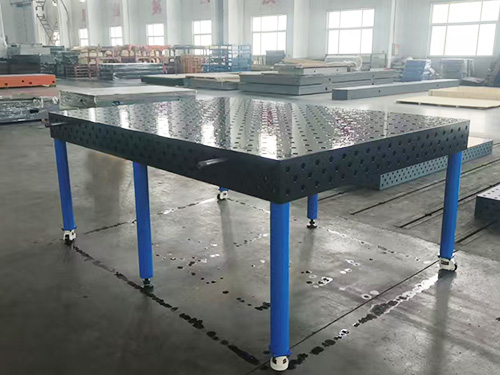
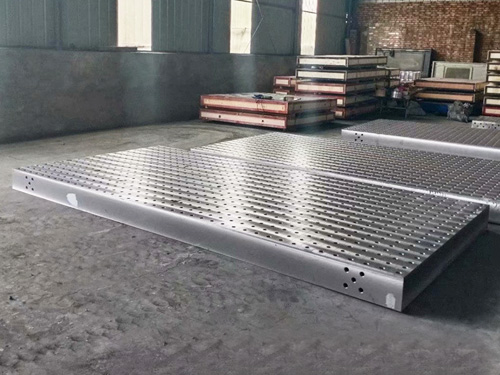
A precision automotive manufacturing welding table provides a rigid, flat, and vibration-resistant surface that ensures components remain accurately positioned throughout the welding cycle. This stability is particularly critical when dealing with repetitive, high-speed welding operations common in automotive production environments.
How Welding Tables Enhance Manufacturing Accuracy
Consistent Positioning and Alignment
Precision welding tables are machined to tight flatness tolerances, enabling accurate positioning of automotive components such as frames, brackets, and subassemblies. This consistency allows both manual and robotic welding systems to perform with repeatable accuracy.
Stable positioning reduces cumulative dimensional errors across large production batches, helping manufacturers maintain uniform quality from the first unit to the last.
Support for Robotic and Automated Welding Systems
As automotive manufacturing increasingly relies on automation, welding tables must integrate seamlessly with robotic welding cells. Modern automotive manufacturing welding tables are designed to support multi-axis robotic access, fixture mounting, and sensor integration.
This compatibility ensures that automated welding systems operate efficiently, delivering consistent weld quality at scale.
Key Benefits of Precision Welding Tables in Automotive Production
Improved Production Efficiency
A well-designed welding table reduces setup time by allowing quick fixture changes and repeatable positioning. Modular hole patterns and standardized clamping systems enable fast transitions between different vehicle components, minimizing downtime.
In high-volume automotive production, these time savings translate directly into increased output and lower operational costs.
Enhanced Weld Quality and Repeatability
Consistency is a defining requirement in automotive welding. Precision welding tables ensure that workpieces remain fixed throughout the welding process, minimizing distortion caused by heat or vibration.
The result is uniform weld penetration, improved joint strength, and reduced variation across production runs.
Long-Term Durability Under Industrial Conditions
Automotive welding environments expose equipment to high heat, spatter, and continuous mechanical stress. Precision welding tables manufactured from high-strength steel or cast iron are built to withstand these conditions without warping or surface degradation.
A durable automotive manufacturing welding table maintains accuracy over long service periods, protecting both equipment investments and product quality.
Improved Workplace Safety
Stable workpiece support reduces the risk of movement-related hazards during welding operations. Many precision welding tables also incorporate grounding features that enhance electrical safety during high-current welding processes.
These safety benefits are particularly important in automated automotive facilities where multiple systems operate simultaneously.
Material Selection and Structural Design
The performance of a welding table depends heavily on its material composition and structural design. Automotive welding tables are typically produced using:
·High-grade steel for strength and load-bearing capacity
·Cast iron for vibration damping and thermal stability
·Surface-treated materials for resistance to corrosion and welding spatter
Experienced manufacturers apply controlled production processes such as stress-relief treatment and precision CNC machining to ensure long-term dimensional stability.
Choosing the Right Welding Table for Automotive Manufacturing
When selecting an automotive manufacturing welding table, several factors should be carefully evaluated:
Load Capacity and Table Size
The table must support heavy automotive components while allowing sufficient space for robotic arms and operator access.
Flexibility and Customization
Automotive production lines often handle multiple vehicle models. Modular designs and customizable fixtures enable one table to support various assemblies efficiently.
Integration with Production Systems
The table should align with existing automation, robotics, and quality control systems to ensure seamless operation.
Manufacturer Production Capability
Working directly with a qualified manufacturer offering scalable production ensures consistent quality, stable delivery schedules, and reliable bulk supply for expanding operations.
The Strategic Advantage of Manufacturer-Level Supply
Sourcing precision welding tables directly from an experienced manufacturer provides several long-term advantages:
·Consistent quality across large production volumes
·Engineering support for automotive-specific applications
·Cost efficiency through direct factory production
·Reliable bulk supply for continuous manufacturing demands
These advantages are essential for automotive manufacturers operating under tight timelines and quality standards.
Conclusion: Building Automotive Excellence on Precision Welding Tables
In automotive manufacturing, precision is not optional—it is fundamental. A high-quality automotive manufacturing welding table plays a vital role in ensuring accurate alignment, efficient production, and consistent weld quality across high-volume manufacturing environments.
Designed and supplied by professional manufacturers with advanced production capabilities, precision welding tables form the foundation of modern automotive welding operations. For manufacturers seeking to improve efficiency, reduce rework, and support scalable production, investing in the right welding table is a strategic decision that delivers long-term value.
References
GB/T 7714:Goldak J, Chakravarti A, Bibby M. A new finite element model for welding heat sources[J]. Metallurgical transactions B, 1984, 15(2): 299-305.
MLA:Goldak, John, Aditya Chakravarti, and Malcolm Bibby. "A new finite element model for welding heat sources." Metallurgical transactions B 15.2 (1984): 299-305.
APA:Goldak, J., Chakravarti, A., & Bibby, M. (1984). A new finite element model for welding heat sources. Metallurgical transactions B, 15(2), 299-305.
 HOT PRODUCTS

 CONTACT US
—— E-mail:project@haoranmj.com
—— Whatsapp:+86 18932785670
—— Tel:+86 18932785670
—— Add:Across from Sanjing Distillery on Road 4, Botou Economic Development Zone, Cangzhou City, Hebei Province