







News Detail
Cast Iron vs Granite Welding Tables: Material Properties and Selection Guide
author:hxrtools Time:2026-05-27 15:41:28 Click:115
Cast Iron vs Granite Welding Tables: Material Properties and Selection Guide
Selecting the right material for welding tables and platforms affects everything from weld quality to long-term accuracy. Cast iron dominates the market, but granite surface plates serve critical roles in inspection and precision assembly. Understanding the fundamental differences between these materials helps manufacturers choose the right platform for their specific applications, avoiding expensive mistakes and performance shortfalls.

Material Properties and Composition
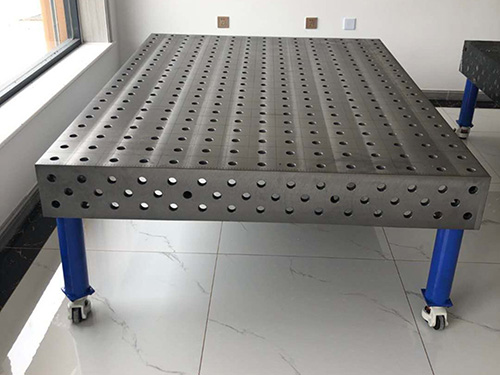
Cast iron welding tables use gray cast iron grades HT200 through HT300, containing 2.5-4% carbon along with silicon and manganese. The graphite flakes provide excellent vibration damping—welding heat and impact forces dissipate rather than reflecting into the workpiece. The material also machines well and accepts surface hardening treatments like high-frequency quenching to achieve surface hardness of HB170-210. Cast iron's interconnected porosity can absorb oil and contaminants, which helps maintain surface condition in workshop environments but may concern clean manufacturing operations.
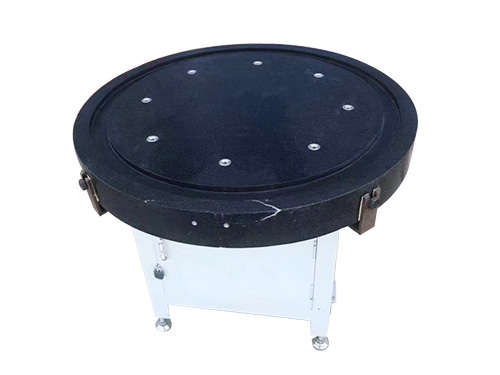
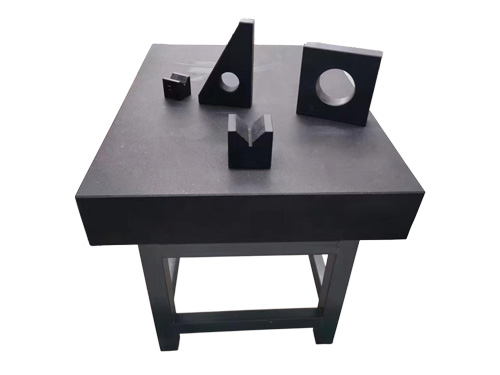
Granite tables use natural stone with fine, uniform grain structure—typically black granite or diabase—that is naturally dimensionally stable and non-porous when properly sealed. Unlike cast iron, granite doesn't require heat treatment because it never develops internal stresses. This inherent stability makes granite attractive for precision metrology and inspection applications where dimensional drift over time is unacceptable.
Thermal conductivity differs significantly. Cast iron conducts heat relatively well, helping dissipate welding warmth but responding to ambient temperature changes. Granite has low thermal conductivity, meaning welding heat stays localized rather than spreading out—a characteristic that can cause thermal expansion issues in granite tables exposed to concentrated welding heat, though it also means granite remains more dimensionally stable in varying ambient temperatures.
Flatness Stability and Dimensional Accuracy
Flatness represents the primary specification for any platform. Cast iron achieves flatness tolerances of 0.05-0.3mm per meter depending on grade and size, but stability depends on proper stress relief during manufacturing. Vibration aging treatment during production minimizes residual stresses that could cause warping over years of service. Without adequate stress relief, cast iron tables deform gradually as internal stresses release. A supplier who implements proper aging treatment provides tables that maintain flatness far longer than untreated alternatives.
Granite excels in long-term flatness stability—it doesn't work-harden or develop stresses from use, maintaining accuracy for decades. However, granite tables face practical size limitations of roughly 4 meters due to transport and quarrying constraints, while cast iron foundries pour single-piece tables exceeding 10 meters for large weldment fabrication. Cast iron tables can be reground to restore flatness after years of heavy service; granite cannot be repaired once the surface wears or chips, making replacement the only option.
Vibration Damping and Impact Resistance
Vibration damping separates these materials in practice. Cast iron's graphite structure absorbs vibrations exceptionally well—when a welder grinds a finished weld, vibrations don't transmit to disturb nearby precision work. Granite dissipates vibrations through its crystalline structure, though not quite as thoroughly. For most welding applications, both materials provide adequate damping. Impact resistance favors cast iron significantly. Dropping a heavy steel component might chip a cast iron table but leave it functional; granite can crack or chip, creating lips that interfere with workpiece placement and ruining local flatness.
Cost Considerations and Total Value
Initial cost favors cast iron for most sizes—cast iron tables cost roughly 30-50% less than granite equivalents. The casting process scales economically for volume production. Large tables reverse this relationship: a 4-meter by 2-meter granite table might cost three times the equivalent cast iron table, making cast iron both more practical and economical for large weldments. Cast iron tables can be reground multiple times, extending service life to 20+ years, while granite requires replacement after damage—though granite in light-duty inspection roles might never need replacement.
Application-Specific Selection Criteria
Choose cast iron for general fabrication, structural welding, and applications involving heavy loads or potential impact—its toughness, repairability, and cost-effectiveness make it the default choice. Most welding workshops find that cast iron handles their needs completely without requiring granite. Select granite for inspection, precision assembly, and applications where long-term dimensional stability without maintenance justifies the premium cost.
Hybrid solutions serve demanding applications well. Some manufacturers offer cast iron tables with granite inserts positioned at critical work areas. Others use granite surface plates on dedicated bases separate from welding tables entirely, reserving the granite for inspection and measurement while keeping cast iron for production welding. These approaches optimize material selection for each function rather than forcing one material to serve all purposes at compromise.
Consulting with experienced manufacturers helps clarify the right choice. A supplier who understands both materials can analyze your workload—workpiece weight, accuracy requirements, environmental conditions, budget constraints—and recommend solutions that balance performance against cost. The correct selection balances multiple factors rather than simply comparing published material property tables.
References
Evans, C. (1989). Precision Engineering: An Evolutionary View. Bedford: Cranfield Press.
International Organization for Standardization. (2014). ISO 8512-2: Surface Plates - Part 2: Granite Surface Plates. Geneva: ISO.
American Society for Testing and Materials. (2019). ASTM A48/A48M: Standard Specification for Gray Iron Castings. West Conshohocken: ASTM.
Slocum, A. H. (1992). Precision Machine Design. Dearborn: Society of Manufacturing Engineers.
 HOT PRODUCTS

 CONTACT US
—— E-mail:project@haoranmj.com
—— Whatsapp:+86 18932785670
—— Tel:+86 18932785670
—— Add:Across from Sanjing Distillery on Road 4, Botou Economic Development Zone, Cangzhou City, Hebei Province