







News Detail
Cast Iron Welding Table: A Reliable Foundation for Heavy-Duty Industrial Welding
author:hxrtools Time:2026-07-12 12:57:12 Click:169
In any high-volume fabrication environment, the work surface beneath your welding torch is one of the most critical pieces of equipment you own. A cast iron welding table delivers the mass, flatness, and durability required to handle demanding welding applications across industries ranging from structural steel to heavy machinery manufacturing. Understanding the specific advantages of cast iron construction helps procurement managers and workshop supervisors make informed decisions when selecting workholding platforms for their operations.
The Material Advantages of Cast Iron in Welding Platforms
Cast iron has been the material of choice for precision measurement and workholding surfaces for centuries, and its properties make it exceptionally well-suited for welding table applications. The high carbon content in cast iron provides excellent vibration dampening, which reduces harmonic oscillation during welding processes. This characteristic is particularly valuable when working with automated or semi-automated welding systems, where consistent arc conditions directly affect weld bead profile and penetration.
The grain structure of quality cast iron also contributes to its ability to withstand repeated thermal cycling without developing micro-cracks or surface degradation. Unlike steel plate alternatives, properly alloyed cast iron resists the type of surface fatigue that leads to premature flatness loss in busy fabrication shops. Manufacturers often subject their cast iron platforms to stress-relief annealing and vibration aging processes to further stabilize the material before final machining.
From a practical standpoint, cast iron surfaces can be repeatedly resurfaced to restore original flatness tolerances, giving cast iron platforms a service life measured in decades rather than years. This longevity makes cast iron an economically sound investment even for shops operating under tight capital budgets.
T-Groove Configurations and Their Role in Fixture Flexibility
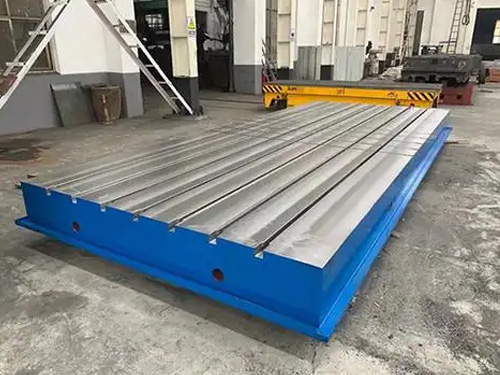
A flat cast iron surface is useful, but a T-groove cast iron platform transforms the work surface into a versatile modular fixturing system. The T-slot pattern, typically spaced at regular intervals across the table surface, accommodates a wide variety of commercial clamps, stops, and custom fixtures. Fabricators can quickly build complex setups for irregularly shaped workpieces without permanent modifications to the table itself.
The T-groove design also facilitates repeatability in production welding environments. Once a setup has been proven effective for a particular assembly, the same fixture positions can be reproduced across multiple shifts or production runs with minimal reconfiguration time. This repeatability is essential for shops that operate under quality management systems requiring consistent process parameters.
Common Industrial Applications
Structural steel fabricators rely heavily on cast iron welding tables for fitting up beams, columns, and plate panels prior to final welding. The flat reference surface ensures that alignment requirements specified in project drawings are met before the welding operator begins the production sequence. Bridge contractors, stadium fabricators, and industrial building constructors all depend on robust welding tables to maintain dimensional accuracy across large assemblies.
Machinery manufacturers use cast iron platforms during the assembly and welding of machine frames, gear housings, and precision components. The flat reference plane provided by the platform serves as a baseline for checking component squareness and parallelism during the fitting-up process. In many cases, welding tables are used in conjunction with precision measurement tools such as dial indicators and height gauges to verify assembly geometry before committing welds.
The shipbuilding industry utilizes large-format cast iron welding platforms in fabrication yards for positioning hull panels and stiffener assemblies. Given the scale of shipyard workpieces, these platforms are often custom-manufactured to accommodate specific vessel section dimensions. Some manufacturers specialize in extra-large welding platforms designed for naval and commercial marine applications, with surface areas exceeding several square meters.
Surface Treatment and Flatness Standards
The working surface of a quality cast iron welding table typically undergoes precision grinding to achieve flatness tolerances within ±0.05mm per meter. This level of precision requires sophisticated CNC grinding equipment and thorough inspection protocols. Buyers should request flatness certification documentation from their manufacturer, ideally including a full-surface coordinate measurement report.
Surface treatments such as sand blasting, painting, or anti-spatter coatings each offer different advantages. Bare machined surfaces provide the highest precision but require careful maintenance. Shot-blasted surfaces offer improved grip for workpieces but may accumulate debris in T-groove channels. Many manufacturers offer multiple surface options so buyers can match the treatment to their specific operational environment.
Customization and Sourcing Considerations
Standard-size welding tables cover the needs of most general fabrication shops, but many applications require custom dimensions or specialized features. Custom platforms can be manufactured to accommodate specific workpiece geometries, unusual fixture requirements, or integration with existing production equipment. When sourcing custom cast iron platforms, working directly with an experienced manufacturer typically yields better results than purchasing through distribution channels that may have limited engineering support capabilities.
A competent manufacturer will review your application requirements, suggest appropriate configurations, and provide detailed drawings for approval before production begins. They should also offer lead times and pricing that reflect the realities of foundry and machining operations, rather than simply quoting catalog items that may not fit your actual needs.
Investing in a quality cast iron welding table pays dividends across every production shift. By matching the platform specifications to your application requirements and maintaining the surface according to manufacturer recommendations, you build a reliable workholding foundation that supports consistent welding quality for years to come.
References:
American Society of Mechanical Engineers. (2022). ASME B29.1: Precision Standard for Transmission, Bicycles, and Agricultural Chains. New York, NY: ASME.
Callister, W. D., & Rethwisch, D. G. (2018). Materials Science and Engineering: An Introduction (10th ed.). Hoboken, NJ: Wiley.
European Committee for Standardization. (2019). EN 1561: Founding—Grey Cast Irons. Brussels: CEN.
 HOT PRODUCTS

 CONTACT US
—— E-mail:project@haoranmj.com
—— Whatsapp:+86 18932785670
—— Tel:+86 18932785670
—— Add:Across from Sanjing Distillery on Road 4, Botou Economic Development Zone, Cangzhou City, Hebei Province