







News Detail
Material Properties of Cast Iron Welding Tables: Grades, Treatment, and Performance
author:hxrtools Time:2026-05-27 15:46:41 Click:169
Material Properties of Cast Iron Welding Tables: Grades, Treatment, and Performance
Walk into any serious fabrication shop or manufacturing facility, and you'll likely find cast iron welding tables anchoring the workspace. Steel plates and aluminum extrusions have their places in fabrication, but cast iron remains the material of choice for precision welding fixtures. Understanding why requires examining the metallurgical properties that make cast iron uniquely suited to the demanding environment of a welding workshop.
Cast Iron Grades for Welding Applications
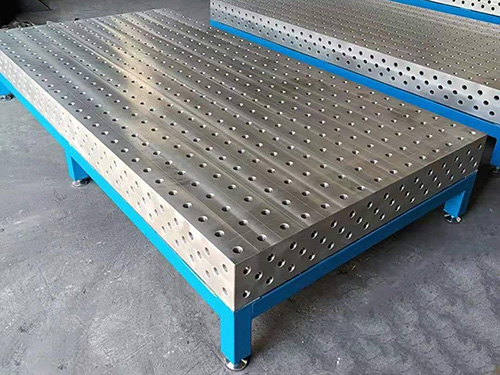
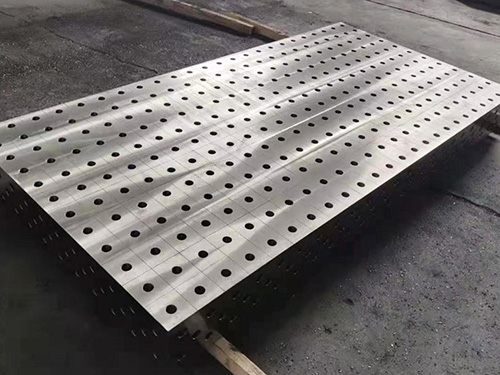
Not all cast iron is created equal. The casting industry classifies gray cast iron using a grading system that indicates tensile strength in megapascals. For welding tables, three grades dominate: HT200 (200 MPa), HT250 (250 MPa), and HT300 (300 MPa). HT200 serves light to medium fabrication work adequately; HT250 occupies the sweet spot for general fabrication with better wear resistance and flatness retention; HT300 targets heavy fabrication and precision applications such as aerospace sub-assemblies and shipbuilding, where the higher graphite content also enhances vibration damping for thin-section welding.
Aging Treatment: Eliminating Internal Stresses
Fresh castings contain internal stresses from the cooling process. As molten iron solidifies and cools to room temperature, different sections cool at different rates, creating residual stresses that can cause warping over time. A welding table that measures perfectly flat when new but warps six months later has likely skipped proper aging treatment.
Responsible manufacturers employ artificial aging as the industry standard: heating castings to 500-600°C, holding for several hours, then slowly cooling. This process eliminates residual stresses from the cooling process in days rather than the 6-18 months natural aging requires. Tables that skip this step might save upfront costs but inevitably warp over time, forcing replacement of expensive fixtures or producing out-of-tolerance welded assemblies.
Flatness Retention Over Decades of Service
A welding table's primary function is providing a reference plane. When that plane deviates from true flatness, every fixture built upon it inherits that error. Cast iron excels at maintaining flatness because of its microstructure: graphite flakes dispersed through an iron matrix create a material that wears gradually rather than galling or developing micro-scratches like hardened steel. This self-lubricating characteristic allows years of heavy use before resurfacing becomes necessary. Steel plates harder than the HB170-210 range tend to develop localized deformations that resist correction through regrinding.
The surface hardness of quality cast iron welding tables falls within HB170-210. This range balances two competing requirements: hard enough to resist indentation from workpiece contact and clamping forces, yet soft enough to allow occasional resurfacing when wear eventually occurs. Steel plates harder than this range tend to develop localized deformations that are difficult to correct.
Maintenance practices significantly influence flatness retention. Welding spatter should be removed promptly using a brass brush or non-marring scraper—allowing hardened spatter to accumulate creates nodules that interfere with fixture placement and can scratch the table surface. Dropping heavy components onto the table creates surface damage that compromises local flatness. Most importantly, workpieces should be positioned to distribute loads evenly rather than concentrating clamping forces at single points. Follow these practices, and a quality cast iron table maintains its reference plane for decades.
Vibration Damping Characteristics
Welding generates vibration. Whether from the welding arc itself, from fit-up hammering, or from grinding operations that inevitably follow welding, these vibrations can degrade weld quality if transmitted to the workpiece. Cast iron's graphite-in-iron microstructure provides exceptional vibration damping, absorbing energy that would otherwise cause weld pool disturbance or arc instability.
This damping proves especially valuable when welding thin-gauge materials—stainless steel panels, aluminum sheets, and similar delicate workpieces benefit from the vibration-free platform that only cast iron provides. The reduced vibration transmission also benefits the welder through less operator fatigue during long sessions, making a measurable difference in end-of-day comfort.
Why Cast Iron Remains the Preferred Material
Steel offers higher strength. Aluminum provides lighter weight. Composite materials promise dimensional stability. Yet cast iron continues to dominate welding table applications, and the reasons extend beyond tradition or inertia.
Cost-effectiveness tops the list. Cast iron delivers machinability, damping, wear resistance, and dimensional stability at a price that keeps fabrication shops profitable. A quality cast iron welding table costs a fraction of equivalent steel or aluminum alternatives while outperforming them in every metric that matters for welding applications. Manufacturers with in-house foundries maintain tight control over material properties—from molten iron to finished table—ensuring consistent graphite distribution, proper stress relief, and verified flatness on every table they ship. The mature supply chain for cast iron tables also enables customization: specific dimensions, hole patterns, slot configurations, or integrated features like clamping channels are available from capable suppliers without exorbitant lead times or premium pricing.
References
Cast Irons, ASM Specialty Handbook, ASM International
GB/T 9439-2010: Gray Cast Iron Grades and Tensile Properties
Foundations of Cast Iron Welding Technology, American Foundry Society
Metals Handbook, Volume 1: Properties and Selection, ASM International
 HOT PRODUCTS

 CONTACT US
—— E-mail:project@haoranmj.com
—— Whatsapp:+86 18932785670
—— Tel:+86 18932785670
—— Add:Across from Sanjing Distillery on Road 4, Botou Economic Development Zone, Cangzhou City, Hebei Province