







News Detail
Custom Welding Workbenches: Tailored Solutions for Complex and Specialized Fabrication Challenges
author:hxrtools Time:2026-07-17 16:21:09 Click:100
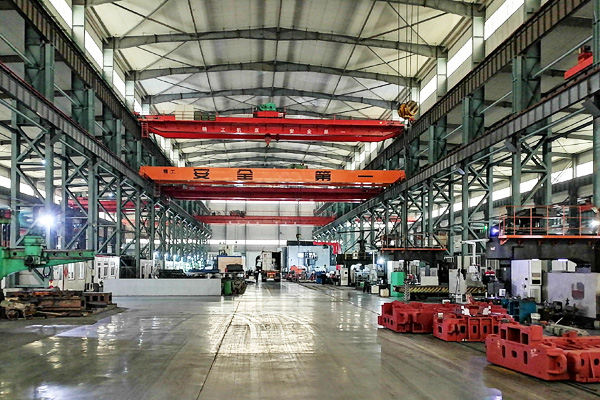
Standard-size welding tables address the needs of many fabrication shops, but numerous applications fall outside the parameters of catalog products. When workpiece geometries are unusually large, when mounting requirements are unconventional, or when integration with existing production equipment is necessary, a custom welding workbench designed to your exact specifications becomes the practical solution rather than a compromise workaround.
When Standard Platforms Are Not Enough
The limitations of standard welding platforms become apparent in several common scenarios. Shipyard fabrication often involves assemblies with hull panel dimensions measured in tens of meters, far exceeding the capacity of commercially available tables. Aerospace contractors may require inspection-grade platform surfaces in specific geometric configurations that standard flat plates cannot provide. Robotics integration projects need welding platforms with precisely positioned mounting points that align with robotic arm reach patterns and tooling angles.
Custom welding workbenches are engineered to address these specific challenges rather than being adapted from general-purpose designs. A custom platform can incorporate reinforced ribs at precisely calculated locations to handle point loads from heavy workpieces, integrated leveling systems for installation on uneven floors, or embedded datum features that serve as permanent reference points for repeated setups.
The engineering consultation that precedes a custom fabrication often identifies efficiencies that the customer had not previously considered. An experienced manufacturer brings application knowledge from similar projects across different industries, suggesting features and configurations that improve functionality in ways the buyer may not have anticipated.
Key Design Parameters for Custom Welding Workbenches
Dimension specifications are the starting point for any custom platform design. Define the maximum and minimum workpiece dimensions the platform must accommodate, along with the required clearances around the workpiece perimeter for clamp access and operator reach. Account for future growth—adding a margin beyond current requirements is often more cost-effective than replacing an undersized platform in a few years.
Load capacity requirements must address both static and dynamic loading conditions. Static load is the combined weight of the workpiece and fixtures resting on the platform. Dynamic load accounts for forces generated during welding operations, including clamping forces, thermal distortion forces, and any impact loads from component handling. A well-engineered custom platform specifies separate ratings for these loading modes rather than using a single conservative figure.
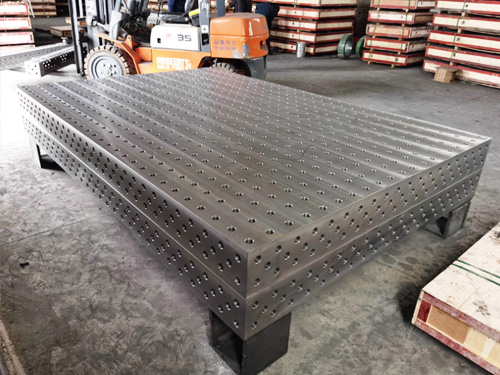
Fixture integration requirements determine the type and layout of mounting features on the working surface. T-slot patterns, threaded mounting holes, precision dowel pin locations, and embedded fixtures can all be incorporated into a custom design. The more precisely these features are defined during the design phase, the better the final platform will serve its intended application.
Material Selection for Custom Applications
Material selection for custom welding workbenches follows the same principles as standard platform selection but with greater flexibility to optimize for specific conditions. Cast iron remains the dominant choice for most custom heavy-fabrication platforms, offering the best combination of mass, vibration dampening, and cost-effectiveness. Custom casting allows the manufacturer to optimize the internal rib structure for the specific load distribution of the intended application.
Fabricated steel structures are commonly specified for custom platforms requiring very large dimensions or unusual geometries that would be impractical or prohibitively expensive to produce as castings. Welded steel fabrications can achieve excellent stiffness-to-weight ratios and can be assembled from standard steel sections and plate material with relatively short lead times.
Hybrid constructions that combine a precision working surface of one material with a support structure of another are also common in custom applications. A granite or precision-ground cast iron working surface mounted on a fabricated steel base combines the best properties of both materials while controlling cost.
The Custom Manufacturing Process
A professional custom platform manufacturer guides customers through a structured design and production process that begins with application consultation and ends with on-site installation verification. The process typically includes preliminary engineering drawings for customer review, final design approval, casting or fabrication, precision machining, flatness certification, and delivery coordination.
Lead times for custom welding workbenches vary depending on complexity and the manufacturer's current production load. Simple dimensional customizations of standard platforms may require only a few additional weeks beyond standard lead times. Fully custom platforms involving new tooling, pattern making, or complex fabrication can require several months from concept to delivery.
Expect the manufacturer to request detailed information about your application before providing a formal quotation. Information about workpiece size and weight, production volume, environmental conditions, and any existing fixture components that must be accommodated all influence the design approach and final price. A manufacturer who asks detailed application questions before quoting is demonstrating engineering rigor, not creating friction in the purchasing process.
Partnering with an Experienced Custom Platform Manufacturer
The manufacturer relationship matters as much as the specifications themselves. Choose a manufacturer with documented experience producing custom platforms for applications similar to yours. Ask for references, review completed project portfolios, and discuss their quality assurance process before committing to a purchase.
A manufacturer who offers application engineering support, on-site installation services, and long-term maintenance and resurfacing capabilities delivers more value than a low-cost supplier who disappears after the sale. The custom platform you invest in today should serve your operation reliably for decades, and a strong manufacturer relationship ensures that support is available whenever you need it.
Custom welding workbenches are a significant investment, but they solve problems that standard products cannot address. By engaging an experienced manufacturer early in the planning process and investing the time to define requirements thoroughly, you receive a platform that performs exactly as needed for your specific application.
References:
American Society of Mechanical Engineers. (2021). ASME Y14.5: Dimensioning and Tolerancing. New York, NY: ASME.
Shigley's Mechanical Engineering Design. (2020). Budynas, R. G., & Nisbett, J. K. (Eds.). Mechanical Engineering Design (11th ed.). New York, NY: McGraw-Hill.
Society of Manufacturing Engineers. (2019). Tool and Manufacturing Engineers Handbook (4th ed.). Dearborn, MI: SME.
 HOT PRODUCTS

 CONTACT US
—— E-mail:project@haoranmj.com
—— Whatsapp:+86 18932785670
—— Tel:+86 18932785670
—— Add:Across from Sanjing Distillery on Road 4, Botou Economic Development Zone, Cangzhou City, Hebei Province