







News Detail
Flexible Welding Platform: Modular Solutions for Adaptive Fabrication Workshops
author:hxrtools Time:2026-07-19 17:00:59 Click:151
The demands placed on modern fabrication shops have changed significantly over the past decade. Production runs are shorter, product variants are more numerous, and the ability to quickly reconfigure a workstation for a different part has become a genuine competitive advantage. Traditional fixed-position welding tables struggle to keep pace with this new operational tempo, which is why many workshops are turning to flexible welding platforms as a core element of their manufacturing strategy.
Understanding Flexible Welding Platform Systems
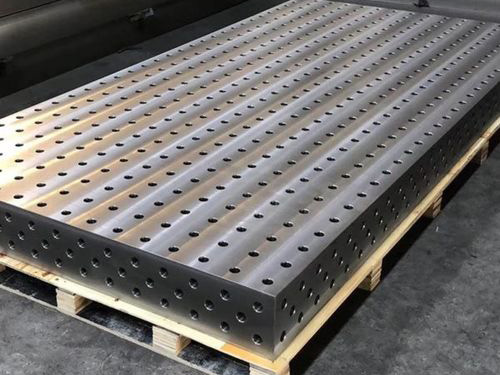
A flexible welding platform is a modular workholding system that allows operators to reposition fixture components across the working surface in virtually any configuration. Unlike traditional solid-top welding tables, flexible systems incorporate grid-patterned mounting holes or T-slot channels that accept a wide range of standardized fixture elements. This modular approach means that a single platform can serve dozens of different workpiece geometries without requiring permanent alterations or additional dedicated tables.
The underlying structure of a quality flexible platform is typically constructed from heavy-gauge steel or precision-machined cast iron, providing the mass and rigidity needed to resist deflection under load. The mounting surface itself is designed to maintain flatness within tight tolerances even after repeated reconfiguration, ensuring that all fixtures return to their intended positions accurately.
Two-Dimensional and Three-Dimensional Flexibility
Two-dimensional flexible welding platforms allow fixture repositioning along the horizontal plane, which handles the majority of fabrication welding scenarios effectively. Operators can slide, rotate, and lock fixture components across the X and Y axes to match the outline of the workpiece being assembled. This is the most common configuration and works well for flat plate assemblies, structural frames, and generally planar fabrications.
Three-dimensional flexible platforms extend the modular concept into the vertical axis, incorporating elevatable fixture stations, angle plates, and adjustable-height support columns. These systems are particularly valuable for prototype shops, custom fabrication departments, and research and development facilities where part geometries change frequently and traditional dedicated jigs would become obsolete too quickly. A 3D flexible platform essentially replaces an entire library of custom jigs with one adaptable system.
Real-World Benefits for Fabrication Operations
The most immediate benefit reported by workshops implementing flexible welding platforms is a dramatic reduction in setup time. When a new production run requires a different workpiece configuration, operators can typically reconfigure a flexible platform in a fraction of the time that would be needed to build or modify a dedicated jig. For shops running multiple small-batch orders per week, this time savings translates directly into improved throughput and reduced labor costs per part.
Floor space utilization also improves significantly. Instead of dedicating separate workstations to specific product families, a single flexible platform can be reconfigured between products throughout the day. This is especially valuable for smaller workshops where floor space is at a premium and every square meter represents a real cost to the business.
Quality consistency benefits as well. Because fixture elements on a flexible platform are typically standardized and repeatable, the same setup can be reproduced across different operators or different shifts with minimal variation. This addresses a common source of dimensional non-conformance in job-shop environments where experienced operators develop personal jigging habits that do not transfer to their colleagues.
Key Features to Evaluate in a Flexible Platform
When evaluating flexible welding platforms for purchase, consider the mounting hole or slot pattern first. A finer grid pattern offers greater positioning resolution, allowing fixtures to be placed with higher precision. However, finer patterns may reduce the effective load capacity of the mounting surface, so match the grid density to your actual precision requirements.
Flatness retention over time is another critical specification. Flexible platforms experience more positional disturbance than fixed tables, with fixture elements being inserted and removed frequently. A well-designed platform maintains surface flatness within acceptable tolerances over thousands of reconfiguration cycles. Ask the manufacturer about the expected maintenance interval for surface inspection and any resurfacing requirements.
Accessory compatibility deserves attention as well. If you already own commercial fixture components, clamps, or stops from specific brands, verify that these will be compatible with the new platform's mounting pattern. Some manufacturers offer proprietary systems that limit your accessory options, while others design their platforms to accept widely available standardized fixture elements.
Selecting the Right Supplier for Your Flexible Platform
The supplier relationship matters significantly with flexible platforms, because the range of available accessories and the manufacturer's engineering support capability directly affect how much value you extract from the system over time. A manufacturer who can provide custom fixture design assistance, application engineering support, and a broad catalog of compatible accessories will deliver more long-term value than a low-cost supplier with a limited product range.
Look for manufacturers with demonstrated experience serving your specific industry segment. A supplier who regularly works with structural steel fabricators will understand the fixture requirements for that application, while a manufacturer focused on aerospace customers will bring different design perspectives and quality standards to the table.
Getting Started with a Flexible Platform Investment
If your shop currently relies on a mix of fixed welding tables and improvised workholding solutions, the transition to a flexible platform can begin with a single platform unit paired with a starter kit of fixture components. As your team becomes familiar with the system, additional accessories and platform modules can be added incrementally to expand capability.
A flexible welding platform is more than a purchase—it is a long-term investment in your workshop's adaptability and competitiveness. By choosing a system matched to your actual production needs and a manufacturer who supports the product over its full service life, you position your operation to respond quickly and confidently to whatever fabrication challenges come next.
References:
Kalpakjian, S., & Schmid, S. R. (2020). Manufacturing Engineering and Technology (7th ed.). Singapore: Pearson.
Society of Manufacturing Engineers. (2018). SME Fundamentals of Tooling and Manufacturing. Dearborn, MI: SME.
Groover, M. P. (2020). Fundamentals of Modern Manufacturing: Materials, Processes, and Systems (6th ed.). Hoboken, NJ: Wiley.
 HOT PRODUCTS

 CONTACT US
—— E-mail:project@haoranmj.com
—— Whatsapp:+86 18932785670
—— Tel:+86 18932785670
—— Add:Across from Sanjing Distillery on Road 4, Botou Economic Development Zone, Cangzhou City, Hebei Province