







News Detail
How a 3D Welding Table Improves Accuracy in Metal Fabrication
author:hxrtools Time:2026-02-27 13:26:33 Click:50
In modern workshops, achieving consistent accuracy is one of the biggest challenges in metal fabrication. Misalignment, distortion, vibration, and thermal movement can all affect weld quality and dimensional precision. This is why the 3D welding table has become an essential tool for professional fabrication environments.
A 3D welding table is more than a flat surface. It is a precision system designed for positioning, clamping, and stabilizing workpieces in three dimensions. Supported by reliable manufacturer production and scalable factory production, 3D welding tables are now widely supplied in bulk for industrial fabrication, robotic welding, and assembly operations.
This article explains how a 3D welding table improves accuracy in metal fabrication and why production quality plays a critical role in performance.
What Is a 3D Welding Table?
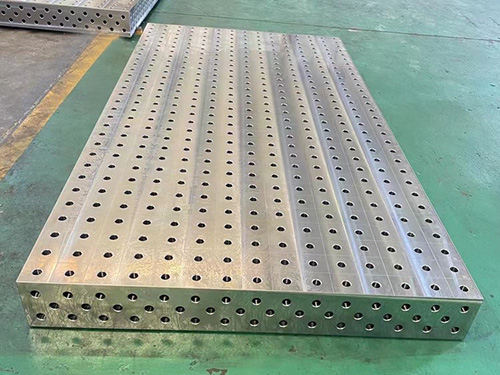
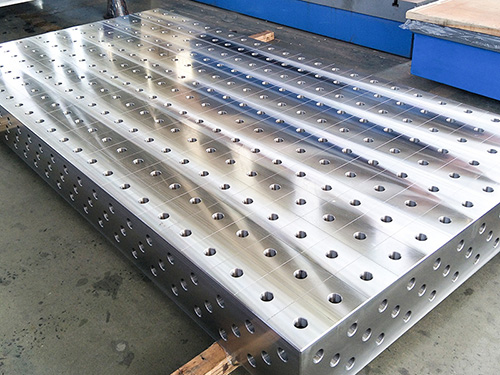
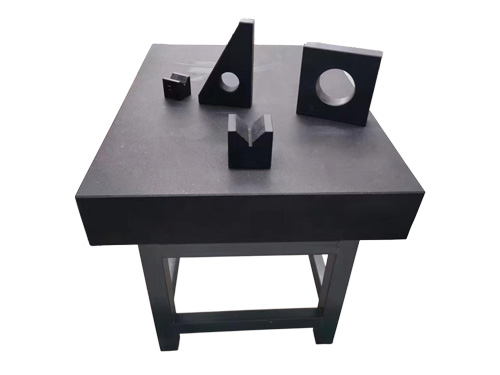
A 3D welding table is a modular, precision-machined work platform with a grid of standardized holes on the tabletop and sometimes on the sides. These holes allow users to install clamps, stops, angles, and fixtures to position parts accurately in X, Y, and Z directions.
Unlike traditional flat benches, a 3D welding table provides:
·Multi-directional positioning
·Repeatable clamping points
·High surface flatness
·Structural rigidity for heavy loads
Through controlled factory production, the table surface is machined to tight tolerances, ensuring consistent accuracy for fabrication, welding, and inspection tasks.
Precision Positioning in Three Dimensions
Accuracy in fabrication starts with positioning. A 3D welding table allows fabricators to locate components precisely using modular stops and fixtures. Instead of measuring and aligning parts repeatedly, the grid system provides fixed reference points.
Key positioning benefits include:
·Consistent part alignment
·Repeatable setups for batch production
·Reduced measurement errors
·Faster fixture installation
With standardized hole patterns produced through manufacturer production, each setup can be reproduced with minimal deviation, greatly improving dimensional control across production runs.
Improved Flatness and Reference Accuracy
Flatness is the foundation of precision welding. Any deviation in the work surface can lead to angular errors, twisting, and assembly problems.
A high-quality 3D welding table offers:
·Machined flat surfaces
·Uniform parallelism
·Stable reference planes
·Controlled surface hardness
These characteristics ensure parts sit correctly before welding begins.
Through professional factory production, stress-relief treatment and precision machining are applied to maintain surface geometry even after long-term use under load and heat.
Enhanced Vibration Control
Vibration affects weld bead quality and joint consistency. Cutting, grinding, and robotic welding all generate micro-movements that can reduce accuracy.
A 3D welding table improves accuracy by:
·Absorbing vibration
·Reducing resonance
·Stabilizing fixtures
·Improving tool control
Better vibration damping keeps components steady during welding, helping operators achieve cleaner joints and tighter tolerances.
During manufacturer production, material selection and internal structure design are optimized to balance rigidity with vibration absorption for industrial workloads.
Thermal Stability During Welding
Welding introduces high localized temperatures that can distort parts and fixtures. If the work surface moves with heat, accuracy is lost.
A professional 3D welding table supports accuracy by offering:
·Predictable thermal behavior
·Even heat distribution
·Resistance to warping
·Stable geometry under repeated cycles
This thermal stability allows fabricators to maintain positioning accuracy even during extended welding operations.
Advanced factory production includes heat treatment and stress relief processes to reduce internal stress and improve long-term dimensional stability.
Modular Clamping for Repeatability
Repeatability is essential for industrial fabrication. The modular design of a 3D welding table allows the same fixture setup to be reused across projects or production batches.
Advantages include:
·Fast reconfiguration
·Standardized clamping locations
·Multi-angle positioning
·Reduced setup time
By using a grid-based system created through manufacturer production, fabricators can achieve consistent results without rebuilding fixtures from scratch.
This improves both accuracy and productivity in metal fabrication environments.
Load Capacity and Structural Rigidity
Heavy components demand strong support. A 3D welding table must carry parts, clamps, and tooling without bending or twisting.
Structural benefits include:
·High load-bearing capacity
·Reinforced table structure
·Minimal elastic deformation
·Stable leg and frame design
Strong rigidity keeps parts in the correct position throughout welding.
Through controlled factory production, rib structures and section thickness are optimized to deliver strength while maintaining manageable weight for industrial use.
Compatibility with Automation and Robotics
Many fabrication workshops now integrate robotic welding systems. Accuracy depends on how well the workbench supports automation.
A 3D welding table improves robotic accuracy by offering:
·Precise fixture positioning
·Stable mounting interfaces
·Consistent geometry for sensors
·Repeatable reference coordinates
Through scalable manufacturer production, tables can be adapted for automated welding cells and high-volume manufacturing environments, ensuring consistent dimensional control across production lines.
How Production Quality Affects Accuracy
Design alone cannot guarantee performance. The real accuracy of a 3D welding table depends on production quality.
Professional factory production integrates:
·Precision machining
·Stress relief heat treatment
·Flatness inspection
·Load testing
·Dimensional verification
These processes ensure each 3D welding table delivered in bulk maintains stable geometry, surface accuracy, and long-term reliability.
Reliable manufacturer production also ensures consistency between batches, which is critical for industrial users operating multiple workstations.
Bulk Supply Advantages for Fabrication Shops
Behind every accurate fabrication system is dependable supply capability. From raw material selection to machining and packaging, every step affects performance.
Strong manufacturer production supports customization and stable quality. Scalable factory production ensures continuous bulk delivery without sacrificing precision.
This production strength allows fabrication shops, system integrators, and equipment planners to build standardized welding stations with predictable accuracy and efficiency.
Conclusion
A 3D welding table significantly improves accuracy in metal fabrication by enhancing positioning precision, surface flatness, vibration control, thermal stability, modular clamping, and structural rigidity. These advantages translate directly into better weld quality, repeatable assembly, and higher production efficiency.
Supported by professional manufacturer production and reliable factory production, a 3D welding table can be supplied in bulk with consistent geometry, strength, and long-term performance.
Choosing the right 3D welding table is not just about a work surface—it is a strategic investment in fabrication accuracy, productivity, and sustainable manufacturing success.
References
GB/T 7714:Kalpakjian S. Manufacturing processes for engineering materials[M]. Pearson Education India, 1985.
MLA:Kalpakjian, Serope. Manufacturing processes for engineering materials. Pearson Education India, 1985.
APA:Kalpakjian, S. (1985). Manufacturing processes for engineering materials. Pearson Education India.
 HOT PRODUCTS

 CONTACT US
—— E-mail:project@haoranmj.com
—— Whatsapp:+86 18932785670
—— Tel:+86 18932785670
—— Add:Across from Sanjing Distillery on Road 4, Botou Economic Development Zone, Cangzhou City, Hebei Province