







News Detail
How to Choose the Right Welding Table Platform for Your Workshop
author:hxrtools Time:2026-05-08 15:47:57 Click:56
A welding table platform is among the most crucial pieces of equipment in any fabrication or metalworking shop. It has a direct impact on the precision, efficiency, and safety of welding operations. Selecting the appropriate table isn’t merely a matter of size or cost—it involves aligning the table’s structure, material, and functionalities with your actual work requirements. This guide outlines the essential factors to keep in mind when picking a welding table platform for your workshop.
1. Clarify Your Work Needs
Prior to buying a welding table, you need to clearly define the type of work you’ll be undertaking. Ask yourself the following questions:
What types of materials will I be welding? (e.g., steel, stainless steel, aluminum)
What is the usual size of my projects?
Do I require it for heavy-duty industrial use or light workshop tasks?
Will I frequently use fixtures and clamps?
Small workshops may only need a compact table, whereas industrial fabrication facilities demand heavy-duty, high-precision platforms.
2. Select the Appropriate Table Material
The material of a welding table influences its durability and heat resistance. Here are the common options available:
Carbon steel: Sturdy, cost-effective, and widely utilized in general welding scenarios.
Cast iron: Boasts excellent stability and heat resistance, making it ideal for precision welding work.
Stainless steel: Corrosion-resistant, suitable for clean or specialized working environments.
For most workshops, carbon steel welding tables provide the optimal balance between cost and performance.
3. Factor in Table Thickness and Load-Bearing Capacity
A welding table must be able to bear heavy loads, withstand high temperatures, and endure impacts from metal components. Key points to consider include:
A thicker tabletop translates to better stability.
High load-bearing capacity ensures safety when working with heavy workpieces.
A reinforced structure extends the table’s service life.
Industrial workshops should opt for heavy-duty platforms equipped with reinforced frames.
4. Flatness and Precision
A high-quality welding table should feature a flat, stable surface. Even minor deviations can compromise welding precision. Look for the following characteristics:
A precision-ground surface
An anti-deformation structure
Stable leveling feet or adjustable supports
If your work involves precision fabrication, flatness is one of the most critical factors to prioritize.
5. Table Size and Flexibility
Choose a size that suits your workspace and the scale of your projects. Common sizes include:
Small: Designed for repair work and light fabrication tasks.
Medium: Suitable for most general workshop needs.
Large industrial tables: Intended for heavy and complex assemblies.
If space is limited, consider modular or expandable welding table systems for added flexibility.
6. Compatibility with Fixture and Clamping Systems
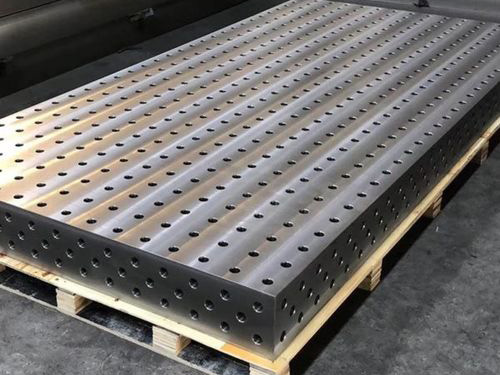
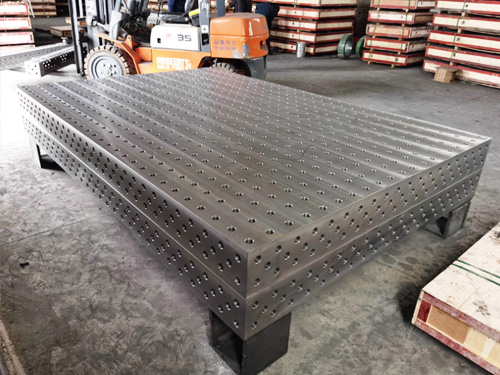
Modern welding table platforms often support fixture systems, such as those with holes, slots, or grid layouts. The benefits of such compatibility include:
Faster workpiece positioning
Enhanced welding accuracy
Better repeatability for batch production
If your work involves repetitive tasks, a table compatible with fixtures is highly advisable.
7. Heat Resistance and Surface Treatment
Welding produces high temperatures and spatter. A reliable table should be resistant to deformation and damage. Look for:
A heat-treated surface
An anti-spatter coating or finish
An easy-to-clean design
These features help maintain the table’s performance over an extended period.
8. Budget vs. Long-Term Value
While cheaper tables may save money upfront, they often wear out quickly or lack the necessary precision. A high-quality welding table offers:
A longer service life
Superior welding accuracy
Higher productivity
Reduced maintenance costs
It’s best to view a welding table as a long-term investment rather than a one-time expense.
Conclusion
Selecting the right welding table platform is vital for improving welding quality and workshop efficiency. By taking into account factors such as material, size, load-bearing capacity, precision, and fixture compatibility, you can choose a table that perfectly matches your work needs. Whether you operate a small workshop or a large industrial facility, the right welding table will significantly boost your productivity and the quality of your welding results.
References
GB/T 7714:The Engineering Behind Stable Welding Platforms. Manufacturing Journal
MLA:Design of the Welding Fixture for the Robotic Stations for Spot Welding Based on the Modular Concept. Acta Mechanica Slovaca
APA:Conceptual Design of Shielded Metal Arc Welding Workstation: Work Posture and Bead Dimension Consideration. Journal of Advanced Manufacturing Technology
 HOT PRODUCTS

 CONTACT US
—— E-mail:project@haoranmj.com
—— Whatsapp:+86 18932785670
—— Tel:+86 18932785670
—— Add:Across from Sanjing Distillery on Road 4, Botou Economic Development Zone, Cangzhou City, Hebei Province