







News Detail
Large Weldment Fabrication: Heavy-Duty Welding Platform and Workbench Solutions
author:hxrtools Time:2026-06-21 04:54:59 Click:186
Large Weldment Fabrication: Heavy-Duty Welding Platform and Workbench Solutions
Fabricating large weldments tests every aspect of welding equipment. When structural steel beams span 10 meters, or ship hull sections weigh 20 tons, the welding platform becomes a critical foundation determining whether the final assembly meets specifications. Heavy-duty welding tables and workbenches solve these challenges through intelligent design, robust materials, and careful attention to load distribution.
Structural Steel Fabrication Challenges
Structural steel fabrication involves welding massive I-beams, H-columns, and plate assemblies that form buildings, bridges, and industrial structures. These components often exceed 10 meters in length and weigh several tons. Standard welding tables simply cannot handle this scale.
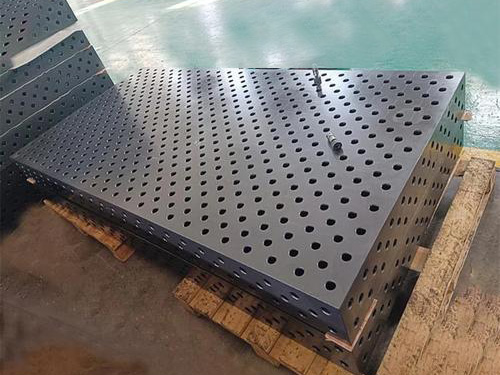
Heavy-duty welding platforms address this through substantial sectional thickness. While small benchtop tables might use 100mm thick castings, large structural welding requires tables 200-400mm thick. This mass serves two purposes: it resists deflection under heavy workpieces, and the thermal mass absorbs heat from welding without distorting.
T-slot and T-groove configurations become essential for large structural work. These slots accommodate heavy-duty clamping systems that resist the forces of welding distortion. As welds cool and contract, they pull with tremendous force. Proper clamping bolted into robust table slots prevents movement that ruins dimensional accuracy.
Load capacity calculations matter. A 3-meter by 1.5-meter welding table made from HT250 cast iron, 250mm thick, supports roughly 8-10 tons distributed load without permanent deformation. Point loads near slot edges require additional consideration. Experienced suppliers calculate these loads during the design phase, ensuring the table withstands years of heavy use.
Ship Hull Section Welding
Shipbuilding represents perhaps the most demanding application for large welding platforms. Hull sections are enormous, curved, and heavy. Fixturing these components demands platforms that are themselves massive, or modular systems that bolt together to create virtually unlimited working areas.
Modular welding platform systems solve the size problem elegantly. Individual table sections—each perhaps 2m x 3m—bolt together with precision alignment pins ensuring flatness continuity across the entire assembly. A shipbuilding workshop might configure 20 or 30 interconnected tables, creating a welding area exceeding 100 square meters.
The 3D flexible welding platform concept adapts well to shipbuilding. Grid hole patterns allow fabricators to mount specialized fixtures that match hull curvature. Rather than building custom fixed tooling for each hull section, the modular platform accepts adjustable supports that create the required contour. This flexibility reduces tooling costs while maintaining accuracy.
Foundries producing these large castings face their own challenges. Pouring a 12-ton table requires coordinated melt capacity—those 8-ton and 10-ton cupolas working in sequence or tandem. Controlling cooling rates for castings of this size demands expertise; uneven cooling creates internal stresses that cause warping later. Suppliers with proven experience in large casting supply command premium prices because their reject rates stay low.
Massive Machinery Component Fabrication
Heavy machinery manufacturing—mining equipment, construction machinery, power generation components—requires welding platforms that accommodate complex geometries and tight tolerances despite enormous size. A welding platform for fabricating excavator arms must maintain accuracy across a 6-meter length while supporting 5+ tons of steel.
CNC machine workbenches designed for large components incorporate features beyond simple flat surfaces. Some include built-in rotary positioning, allowing weldments to rotate for downhand welding. Others integrate hydraulic height adjustment, bringing the work to ergonomic working heights. These features transform a basic welding table into a comprehensive fabrication station.
Inspection and testing platforms play a crucial role in large weldment fabrication. After welding, large components need dimensional verification before proceeding to the next assembly stage. Inspecting a 15-ton weldment requires a level, stable surface—essentially a massive surface plate. Cast iron inspection platforms provide this stability, with flatness verified by laser trackers or photogrammetry systems when components exceed CMM capacity.
The supply chain for these large platforms involves coordination between multiple specialized shops. Pattern making for large castings, foundry work, rough machining, finish machining, stress relief, and final inspection—each step requires different expertise. Manufacturers who control the entire process deliver better quality because they catch issues early. When a machine shop discovers a casting defect after machining, the cost is far higher than if the foundry had caught it.
Design Considerations for Large Platforms
Designing welding platforms for large weldments requires balancing several factors. Flatness requirements drive thickness and ribbing patterns. A 6-meter table with 0.1mm/m flatness needs substantially more structural reinforcement than one with 0.5mm/m tolerance.
Ribbing design underneath the table surface distributes loads and prevents deflection. Finite element analysis helps optimize rib placement, minimizing weight while maximizing stiffness. Poor ribbing design creates soft spots where the table deflects under load, compromising accuracy. Quality suppliers use computer modeling to validate their designs before cutting patterns.
Surface preparation affects weld quality directly. Scale, rust, or contamination on the welding platform transfers to workpieces or interferes with grounding. Large platforms need accessible surfaces for cleaning and maintenance. Some designs incorporate removable surface plates, allowing worn sections to be replaced without scrapping the entire table.
Transportation and installation present practical challenges. A one-piece 15-ton welding table requires specialized freight and lifting equipment. Some suppliers address this by designing sectional tables that assemble on-site. Bolting sections together with precision alignment restores flatness while making transport manageable. This approach also allows future expansion—adding table sections as workshop needs grow.
References
Blodgett, O. W. (2011). Design of Welded Structures. Cleveland: The Lincoln Electric Company.
American Institute of Steel Construction. (2016). Steel Construction Manual (15th ed.). Chicago: AISC.
International Organization for Standardization. (2018). ISO 3834: Quality Requirements for Fusion Welding of Metallic Materials. Geneva: ISO.
Kou, S. (2003). Welding Metallurgy (2nd ed.). Hoboken: Wiley.
 HOT PRODUCTS

 CONTACT US
—— E-mail:project@haoranmj.com
—— Whatsapp:+86 18932785670
—— Tel:+86 18932785670
—— Add:Across from Sanjing Distillery on Road 4, Botou Economic Development Zone, Cangzhou City, Hebei Province