







News Detail
T-Slot Platform Applications in Welding and Fabrication: Clamps, Fixtures, and Positioning Systems
author:hxrtools Time:2026-06-30 08:42:23 Click:67
T-Slot Platform Applications in Welding and Fabrication: Clamps, Fixtures, and Positioning Systems
T-slot platforms have earned their place in fabrication shops worldwide by solving a fundamental problem: how to securely hold workpieces of wildly different shapes and sizes using a single table surface. The genius of the T-slot design lies in its simplicity—machined grooves running across the table surface accept standard T-nuts and clamps, creating infinite possibilities for workpiece positioning and securement.
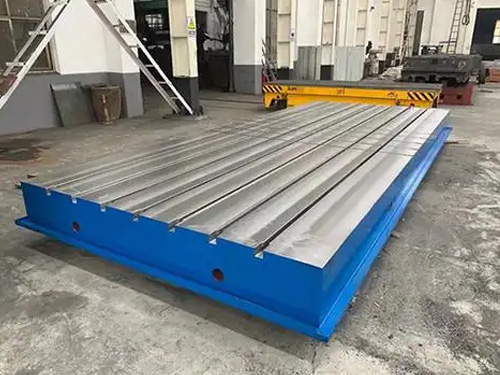
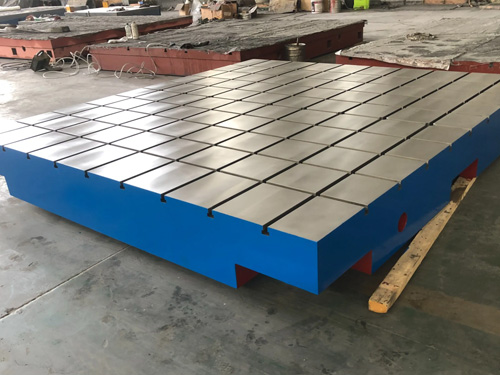
Anatomy of a T-Groove Table
A T-slot consists of a wide lower channel and a narrow upper opening. This geometry allows T-nuts, studs, and specialized clamps to slide into the slot and lock in place by rotating 90 degrees or tightening a hex nut. The slot runs the full length or width of the table, providing continuous clamping capability wherever the workpiece requires support.
Table design varies by application. Some platforms feature parallel slots running in one direction, while others incorporate a grid pattern with slots running both lengthwise and widthwise. The grid configuration offers maximum flexibility, allowing clamps to approach the workpiece from any angle. Heavy-duty tables often include slots on 100mm centers, while precision tables for finer work may use 50mm or 75mm spacing.
The slot dimensions themselves follow standardized conventions. Common sizes include 12mm, 14mm, 18mm, 22mm, and 28mm slot widths, with corresponding T-nuts and clamping hardware. This standardization means clamps purchased for one table work perfectly on another table with matching slot dimensions—a significant advantage for workshops operating multiple stations or planning future expansion.
Clamping Systems and Workholding Strategies
The ecosystem of T-slot clamping hardware rivals that of any machine tool. Step clamps, toe clamps, swing clamps, and toggle clamps all find applications in welding fixture builds. Each type serves specific purposes: step clamps excel at securing flat plates, toe clamps grip workpiece edges without interfering with welding access, and swing clamps provide clearance for loading and unloading.
Building an effective fixture starts with identifying the workpiece's natural datums—machined surfaces, precision holes, or established edges that define the part's coordinate system. T-slot clamps then secure these datums relative to the table surface, creating a reference framework for all subsequent welding operations. This approach ensures that welded sub-assemblies accumulate minimal positional error, even across multi-stage fabrication processes.
Experienced fixture builders understand the importance of clamp placement. Clamps should oppose each other across the workpiece to prevent shifting under welding stresses. They should also position clear of the welding arc path, avoiding situations where the welder must weld around or through clamping hardware. Thoughtful clamp placement separates professional fixture design from amateur efforts.
Universal Positioning Systems
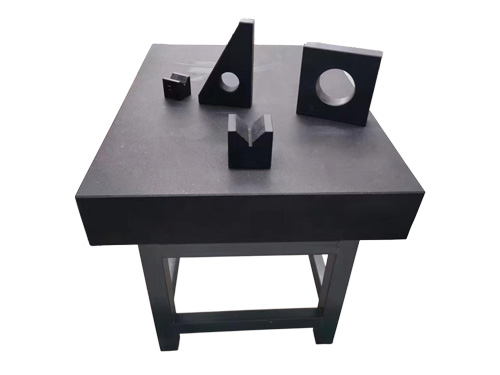
The true power of T-slot platforms emerges when combining them with modular positioning components. Datum blocks, angle plates, and adjustable supports all interface with T-slots to create three-dimensional fixture structures. A single T-slot table thus transforms into a versatile coordinate measuring and welding setup platform.
Datum blocks deserve particular attention. These precision-machined components bolt into T-slots and provide accurate reference surfaces for workpiece positioning. Quality datum blocks undergo grinding to achieve flatness within 0.02mm per 100mm, ensuring that workpieces positioned against them inherit this accuracy. When a supplier provides datum blocks with certified flatness, they enable welding fixtures that approach machining center precision.
Angle plates and right-angle brackets expand positioning possibilities into the vertical plane. Welding isn't limited to horizontal surfaces—many assemblies require vertical or angled welding accesses. T-slot compatible angle plates bolt securely to the table, then accept additional clamps and supports to hold workpieces at precise angles. This capability proves essential for structural fabrications involving intersecting members, brackets, and frame assemblies.
Benefits for Repetitive Fabrication Work
Production welding demands consistency. When a fabrication shop produces the same welded assembly across multiple units—whether ten pieces or ten thousand—fixture repeatability determines both quality and profitability. T-slot platforms excel in this environment because clamps and positioning elements return to the same locations repeatedly.
Smart shops take this repeatability further by marking optimal clamp positions. Once an ideal fixture configuration is established, operators record slot positions and component identities. Subsequent setups replicate the configuration rapidly, eliminating trial-and-error positioning. Some workshops even maintain dedicated T-slot fixtures for their highest-volume products, leaving clamps partially assembled between production runs.
The economic argument for T-slot platforms strengthens when calculating fixture costs per part. Dedicated welded fixtures require design time, materials, machining, and storage space. T-slot fixtures require only the time to position and tighten clamps—no design, no machining, no storage. For low-to-medium volume production, this advantage alone justifies the investment in quality T-slot equipment.
Adapting to Custom and One-Off Fabrication
Job shops specializing in custom fabrication face the opposite challenge: extreme part variety with minimal repetition. Here, T-slot platforms demonstrate perhaps their greatest value. Without a T-slot table, each custom part demands either a custom fixture (expensive, time-consuming) or manual positioning (imprecise, inconsistent).
T-slot fixtures adapt to custom work because the underlying system remains constant while the arrangement changes. An experienced fitter-welder develops an intuition for quick fixture setups: which clamps work best for thin-wall tubing, how to support large plates to prevent sagging, where to position stops for repeatable angle cuts. This knowledge transfers across every custom job, building cumulative expertise rather than starting from zero each time.
Manufacturing suppliers recognize this adaptability and now offer specialized T-slot accessories for niche applications. Pipe welding receives dedicated V-block supports that bolt into T-slots. Sheet metal forming gets bend allowance gauges that clamp securely to the table edge. Robotic welding integration benefits from T-slot mounting patterns that align perfectly with robot base plates. The ecosystem continues expanding as more fabricators discover T-slot versatility.
Selecting Quality T-Slot Platforms
Not every T-slot table delivers equal performance. Inferior products suffer from sloppy slot dimensions, soft material that deforms under clamping loads, and poor flatness that compromises workpiece accuracy. Evaluating potential suppliers requires examining their manufacturing capabilities and quality control processes.
Precision machining separates professional-grade tables from workshop-built alternatives. CNC machining ensures slot alignment, spacing accuracy, and flatness that manual methods cannot achieve consistently. The best manufacturers combine experienced machinists with modern equipment to produce tables that maintain tolerances across their entire surface area.
Material selection also matters. Cast iron remains preferred for most welding applications due to its vibration damping and wear resistance. Steel T-slot tables find use in heavy-duty applications where maximum strength matters more than vibration damping. Aluminum T-slot tables serve portable or weight-sensitive applications, though they sacrifice durability compared to ferrous alternatives.
References
Welding Fixture Design Principles, Tool and Manufacturing Engineers Handbook, SME
ISO 2768-1:1989: General Tolerances for Linear and Angular Dimensions
Jig and Fixture Design Manual, Industrial Press
GB/T 22095-2008: Cast Iron Surface Plates and Tables
 HOT PRODUCTS

 CONTACT US
—— E-mail:project@haoranmj.com
—— Whatsapp:+86 18932785670
—— Tel:+86 18932785670
—— Add:Across from Sanjing Distillery on Road 4, Botou Economic Development Zone, Cangzhou City, Hebei Province