







News Detail
Top Features to Look for in an Industrial Welding Workbench
author:hxrtools Time:2026-02-24 12:50:28 Click:163
Choosing the right industrial welding workbench is essential for achieving consistent weld quality, improving productivity, and maintaining long-term operational stability. In fabrication shops, assembly plants, and automated welding lines, the workbench is not just a table—it is the foundation for positioning, clamping, heat control, and structural accuracy.
An effective industrial welding workbench must withstand heavy loads, vibration, heat, and repetitive mechanical stress. Backed by professional manufacturer production and scalable factory production, modern workbenches are designed for bulk supply in industrial environments where durability and precision matter. This article explores the top features to look for in an industrial welding workbench and why production quality directly impacts real-world performance.
Structural Stability and Rigidity
One of the most important features of an industrial welding workbench is structural stability. Welding operations often involve heavy components, fixtures, and tooling systems. Any deflection or movement during welding can introduce alignment errors and reduce joint accuracy.
A high-quality workbench offers:
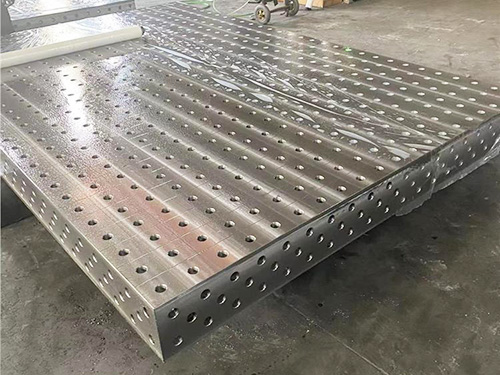
·Thick tabletop construction
·Reinforced rib structures
·High compressive strength
·Minimal elastic deformation
These characteristics ensure that frames, pipes, and assemblies remain stable during positioning and welding.
During manufacturer production, material selection and internal reinforcement are optimized to increase stiffness while controlling overall weight for industrial applications.
High Load-Bearing Capacity
An industrial welding workbench must safely support heavy parts, clamps, jigs, and automated equipment. Load capacity directly affects workplace safety and process reliability.
Key load-related features include:
·High static and dynamic load ratings
·Resistance to bending and twisting
·Stable leg and frame geometry
·Even weight distribution
Whether used in manual welding or robotic systems, a strong workbench reduces vibration and prevents long-term structural fatigue.
Through controlled factory production, frame welding, machining, and stress-relief processes ensure the workbench maintains its shape under continuous heavy-duty use.
Heat Resistance and Thermal Stability
Welding generates high localized temperatures that can cause surface distortion or warping. A reliable industrial welding workbench must handle repeated heating and cooling cycles without losing flatness.
Important thermal features include:
·Low thermal deformation behavior
·Even heat distribution
·Resistance to surface cracking
·Stable geometry under temperature changes
Thermal stability allows consistent part positioning even after prolonged welding sessions.
Advanced manufacturer production often includes heat treatment and stress relief to minimize internal tension and improve long-term dimensional stability.
Precision Flatness and Surface Accuracy
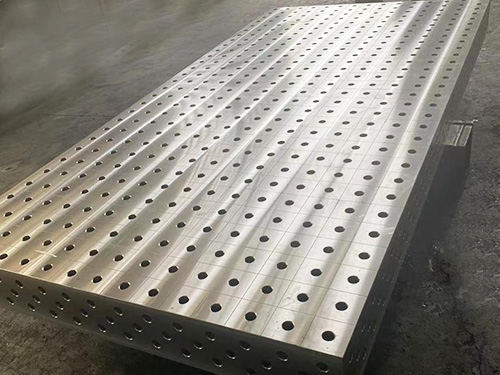
Accuracy starts with the work surface. An industrial welding workbench must provide a flat and repeatable reference plane for clamping, measuring, and assembling parts.
Precision features include:
·Machined or ground surfaces
·Consistent parallelism
·Tight flatness tolerances
·Stable surface hardness
These properties help ensure square joints, accurate alignment, and repeatable production results.
With professional factory production, machining and inspection systems verify surface quality before bulk delivery to industrial users.
Vibration Damping Performance
Vibration is unavoidable in welding, grinding, drilling, and cutting processes. Excessive vibration reduces weld accuracy and increases operator fatigue.
An effective industrial welding workbench provides:
·Natural vibration absorption
·Reduced resonance
·Improved fixture stability
·Enhanced tool control
Better damping improves weld bead consistency and protects both tooling and components.
During manufacturer production, structural design and material composition are adjusted to balance rigidity with vibration control for industrial workloads.
Modular and Flexible Design
Modern fabrication requires flexibility. An industrial welding workbench should support different product sizes, tooling systems, and clamping configurations.
Common modular features include:
·Standardized hole patterns
·Interchangeable fixtures
·Expandable frames
·Adjustable working height
This flexibility allows the same workbench to be used for multiple production tasks without redesigning the workspace.
Scalable factory production supports customization of dimensions, layouts, and mounting interfaces for bulk industrial projects.
Surface Protection and Durability
Industrial environments expose equipment to spatter, impact, dust, and chemicals. A durable industrial welding workbench should resist surface damage and wear.
Durability features include:
·Anti-spatter coatings
·Corrosion-resistant finishes
·Hardened surfaces
·Easy-clean structures
These features extend service life and reduce maintenance downtime.
With reliable manufacturer production, surface treatments and finishing processes improve long-term performance in harsh workshop conditions.
Ergonomic and Safety Considerations
Operator safety and comfort influence productivity. An industrial welding workbench should support safe working posture and controlled part handling.
Important ergonomic features include:
·Proper working height
·Stable clamping zones
·Smooth edges and corners
·Load accessibility
These design elements reduce fatigue and improve welding consistency during long shifts.
Professional factory production integrates ergonomic standards into frame layout and surface geometry to support safe industrial workflows.
Compatibility with Automation Systems
Many modern workshops integrate robots, positioners, and automated welding cells. An industrial welding workbench must be compatible with automation interfaces.
Automation-related features include:
·Mounting points for robots
·Fixture alignment accuracy
·Cable routing channels
·Sensor integration space
This compatibility supports consistent and scalable production.
Through manufacturer production, workbench platforms can be adapted for automated welding lines and high-volume manufacturing environments.
How Production Quality Shapes Performance
Even the best design fails without consistent manufacturing. The real performance of an industrial welding workbench depends on production accuracy and process control.
High-level factory production integrates:
·Precision machining
·Frame welding inspection
·Stress relief treatment
·Load testing
Flatness verification
These steps ensure every industrial welding workbench delivered in bulk supply maintains structural strength, surface accuracy, and vibration stability.
Reliable manufacturer production also improves traceability and repeatability across large-scale industrial projects.
Bulk Supply Advantages for Industrial Users
Behind every professional workshop system is dependable production capacity. From material sourcing to assembly and packaging, each stage influences reliability.
Professional manufacturer production supports customization and consistent quality. Strong factory production enables continuous bulk delivery without sacrificing mechanical accuracy or surface performance.
This production capability reduces operational risk for fabrication plants, system integrators, and equipment planners.
Conclusion
A high-quality industrial welding workbench is defined by stability, load capacity, thermal resistance, surface accuracy, vibration control, modularity, and durability. These features directly influence weld precision, productivity, and long-term equipment reliability.
Supported by professional manufacturer production and scalable factory production, industrial welding workbenches can be supplied in bulk with consistent structure, precision surfaces, and dependable performance.
Choosing the right industrial welding workbench is not just about furniture—it is a strategic investment in welding quality, operational efficiency, and sustainable manufacturing success.
References
GB/T 7714:Kalpakjian S. Manufacturing processes for engineering materials[M]. Pearson Education India, 1985.
MLA:Kalpakjian, Serope. Manufacturing processes for engineering materials. Pearson Education India, 1985.
APA:Kalpakjian, S. (1985). Manufacturing processes for engineering materials. Pearson Education India.
 HOT PRODUCTS

 CONTACT US
—— E-mail:project@haoranmj.com
—— Whatsapp:+86 18932785670
—— Tel:+86 18932785670
—— Add:Across from Sanjing Distillery on Road 4, Botou Economic Development Zone, Cangzhou City, Hebei Province