







News Detail
Welding Table Platform Design Trends in Modern Metal Fabrication Industry
author:hxrtools Time:2026-05-20 19:15:28 Click:102
As the metal fabrication industry advances toward higher precision, automation, and operational efficiency, welding table platforms are experiencing profound transformations. No longer confined to simple flat steel surfaces, modern welding tables have evolved into engineered systems that integrate modularity, digital manufacturing technologies, and advanced material applications. This article explores the cutting-edge design trends that are reshaping welding table platforms in today’s metal fabrication industry.
1. Emergence of Modular and Configurable Table Systems
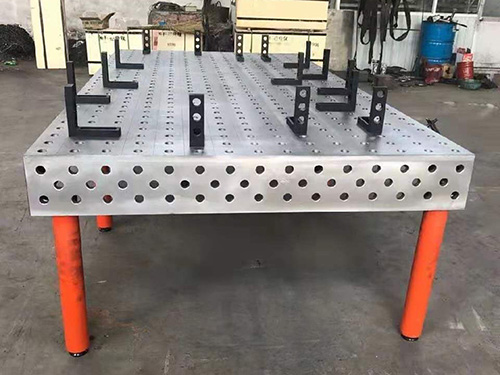
One of the most prominent trends is the transition from fixed welding tables to modular systems. Modern modular welding tables are equipped with interchangeable components and expandable sections, allowing users to reconfigure their layouts according to different project requirements. They also support scalable workspaces by connecting multiple table units together. These modular systems enable fabricators to adapt swiftly to changing production demands, enhancing operational flexibility and minimizing downtime. In high-mix production environments—where diverse and complex fabrication tasks are common—modularity has become an indispensable feature.
2. Popularization of 3D Welding Table Technology
Traditional 2D flat welding tables are gradually being replaced by 3D welding tables, which offer more versatile functionality. Key features of 3D welding tables include multi-sided hole systems (covering the top, sides, and edges), full 3-axis (X, Y, Z) fixturing capabilities, and enhanced positioning options for complex assemblies. With the ability to build fixtures in multiple directions, 3D modular tables are well-suited for intricate structural components and high-precision fabrication work, addressing the limitations of traditional 2D tables.
3. Precision CNC Machining and Strict Tolerance Control
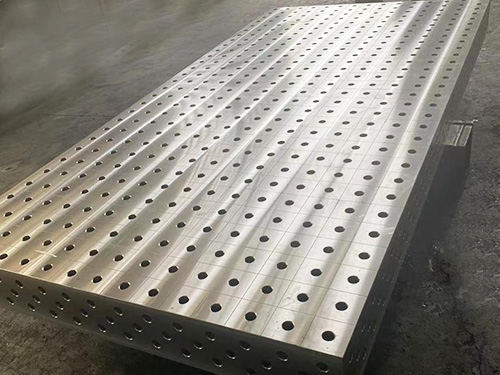
Contemporary welding tables are now manufactured using CNC (Computer Numerical Control) machining technologies, which have significantly elevated their accuracy. The benefits of CNC machining include extremely flat surfaces with tolerances as tight as ±0.1 mm, precise hole spacing and alignment, and consistent repeatability across production cycles. This high level of precision ensures better part fit-up, reduces operational errors, and delivers higher-quality welds in various industrial applications.
4. Advanced Surface Treatments and Material Innovations
Material innovation is another key driver of welding table evolution. Manufacturers are focusing on enhancing the durability and performance of welding tables through advanced surface treatments. Common advancements include nitrided surfaces for improved wear resistance and hardness, anti-spatter coatings that facilitate easier cleaning, and corrosion-resistant finishes to extend service life. Nitriding, in particular, stands out for its ability to enhance scratch resistance, prevent rust formation, and help maintain long-term flatness even under heavy and continuous use.
5. Standardized Hole Grid Systems for Efficient Fixturing
Precision hole grid systems remain a core feature of modern welding tables but have become more standardized and refined. Typical configurations include 16 mm or 28 mm holes with 50 mm or 100 mm grid spacing. These standardized systems enable fast and repeatable setups, improve compatibility with various clamps and accessories, and support automation and fixture standardization. Modern designs prioritize the accuracy of hole placement, ensuring reliable positioning for high-precision welding tasks.
6. Integration with Automation and Robotic Welding Systems
As factories increasingly adopt automation technologies, welding tables are being designed to integrate seamlessly with robotic welding arms, CNC systems, and automated production lines. Key design considerations for this integration include high repeatability to support robotic operations, rigid structures capable of withstanding continuous use, and compatibility with digital workflows. This trend aligns with the broader shift toward smart manufacturing and Industry 4.0, where interconnected equipment enhances overall production efficiency.
7. Focus on Scalability and Workspace Optimization
Modern workshops require efficient use of available space, and welding tables are now designed with this in mind. Key features include expandable configurations, foldable or extendable surfaces, and compact modular layouts. These design elements allow manufacturers to maximize productivity even in workshops with limited space.
8. Enhanced Ergonomics and Adjustability
Operator comfort has become a growing focus in welding table design. New ergonomic features include adjustable height systems, mobile tables equipped with locking casters, and flexible positioning options for different tasks. Adjustable height ranges—typically 850–1150 mm—help reduce operator fatigue and improve welding precision by allowing workers to operate in the most comfortable position.
9. Multi-Functionality Beyond Traditional Welding
Modern welding tables are no longer limited to welding tasks alone. They are increasingly being used for a variety of related operations, including assembly, inspection, cutting and grinding, and CNC fixturing. This multi-purpose functionality improves equipment utilization and reduces the need for separate workstations, streamlining workshop operations.
10. Prioritization of Durability and Long-Term Performance
Industrial users demand welding tables that offer long service life and consistent performance. As a result, manufacturers are prioritizing heavy-duty steel construction, reinforced frames, and resistance to heat, heavy loads, and wear. Modern welding tables are engineered to maintain flatness and structural integrity even under continuous, high-intensity industrial use.
Conclusion
The design of welding table platforms is evolving rapidly to keep pace with the changing needs of modern metal fabrication. Key trends such as modularity, 3D functionality, CNC precision, advanced materials, and automation integration are transforming welding tables into highly versatile and intelligent work systems. For fabrication businesses, adopting these modern welding table designs brings numerous benefits, including greater operational flexibility, higher precision, improved efficiency, and a better long-term return on investment. As the metal fabrication industry continues to advance, welding tables will play an increasingly critical role in enabling precision-driven, scalable, and automated manufacturing environments.
References
GB/T 7714:Modular and 3D Welding Tables: Trends Shaping Modern Metal Fabrication. Journal of Industrial Fabrication
MLA: Integration of Welding Tables with Robotic Automation in Smart Factories. Materials and Manufacturing Processes
APA:CNC Machining and Surface Treatments for High-Precision Welding Tables. International Journal of Advanced Manufacturing Technology
 HOT PRODUCTS

 CONTACT US
—— E-mail:project@haoranmj.com
—— Whatsapp:+86 18932785670
—— Tel:+86 18932785670
—— Add:Across from Sanjing Distillery on Road 4, Botou Economic Development Zone, Cangzhou City, Hebei Province