







News Detail
Welding Platform Applications in Aerospace, Shipbuilding, and Automotive Industries
author:hxrtools Time:2026-07-09 11:41:11 Click:58
Welding platforms endure some of the harshest working conditions in manufacturing. Different industries push these tools to their limits in distinct ways, demanding specific accuracy levels, material properties, and durability features. Understanding how aerospace, shipbuilding, and automotive sectors use welding platforms reveals why quality matters in these demanding applications.
Aerospace: Where Tolerances Define Success
Aerospace fabrication tolerates zero margin for error. Aircraft components must align perfectly—a 0.5mm deviation in a wing rib fixture translates to aerodynamic problems that compound through the entire assembly. Welding platforms serving this industry require flatness tolerances of 0.05mm per meter or tighter.
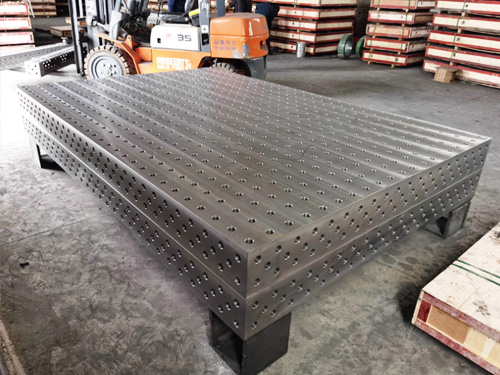
The 3D flexible welding platform concept gained traction in aerospace because it allows rapid reconfiguration. Instead of building dedicated fixtures for each component, manufacturers use modular platforms with grid hole patterns. Fixture elements clamp into these holes at precise intervals, creating custom setups that adapt as designs evolve. This flexibility proves essential when prototyping new aircraft components or handling low-volume production runs.
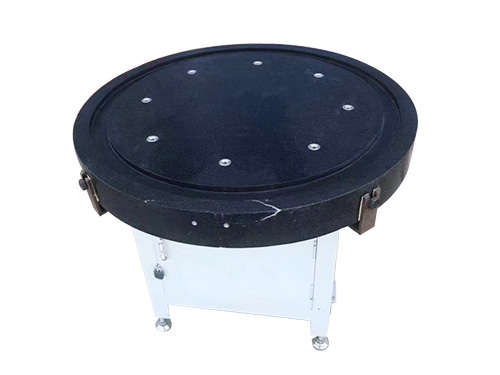
Material stability becomes critical in climate-controlled aerospace factories. Temperature fluctuations cause cast iron to expand and contract, potentially throwing off precision assemblies. Quality welding platforms minimize this effect through proper material selection and stress relief processing. Some aerospace suppliers even specify granite welding tables for inspection tasks because granite's thermal coefficient matches measurement equipment better than cast iron.
Surface hardness matters tremendously. Aerospace components often involve expensive materials—titanium, Inconel, specialty aluminum alloys. Scratching these materials during fixture setup creates reject parts costing thousands of dollars. Welding platforms with properly hardened surfaces (HB170-210 range) resist damage while protecting sensitive workpieces.
Shipbuilding: Scale and Durability Under Extreme Conditions
Shipbuilding presents the opposite challenge from aerospace: instead of tiny tolerances on small parts, shipbuilders need moderate tolerances across enormous structures. A welding platform used to fixture a ship hull section might be 10 meters long, where 2-3mm total deviation across the entire length is acceptable.
The demand here focuses on durability rather than extreme precision. Shipbuilding workshops expose welding platforms to heavy structural steel plates, powerful clamping forces, and constant impact from handling. Cast iron welding tables with T-slots provide the strength needed, with table thicknesses often exceeding 300mm to resist deflection under massive loads.
Corrosion resistance becomes a major concern. Shipbuilding happens in coastal environments where salt spray penetrates everything. Welding platforms supplied to shipyards need surface treatments that prevent rust formation. Some manufacturers apply chemical conversion coatings or oil impregnation to cast iron surfaces, extending service life in harsh conditions.
Large-scale welding platforms for shipbuilding often incorporate multiple sections that bolt together. This modular approach allows shipyards to reconfigure their workspace as project requirements change. A supplier offering these large machine tool castings must maintain foundry capacity for massive pours—8-ton and 10-ton cupolas become necessary to produce single-piece tables exceeding 5 tons.
Automotive: High-Volume Production Demands
Automotive manufacturing operates at volumes that dwarf other industries. While aerospace builds hundreds of aircraft annually, automotive plants weld thousands of vehicles daily. Welding platforms in this sector must maintain accuracy through relentless repetition while supporting rapid changeovers between model variants.
Robotic welding cells rely heavily on precision positioning. Robots follow programmed paths measured in millimeters, and any deviation in the welding platform geometry creates defective parts. Automotive suppliers often specify 3D coordinate detection verification for every platform, ensuring robot reach and accuracy remain consistent across the production floor.
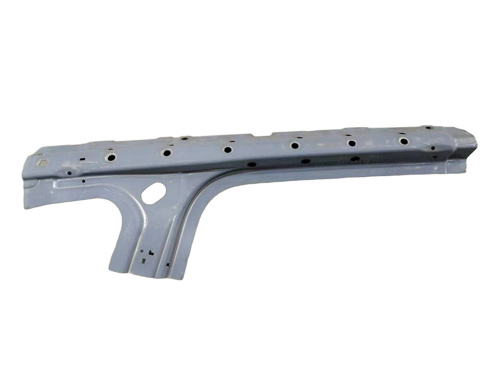
The 2D flexible welding platform finds particular application in automotive body assembly. These platforms provide precise locating points for sheet metal components, allowing spot welding robots to join panels with repeatable accuracy. Unlike heavy structural welding, automotive body assembly demands smooth, flat surfaces that won't mar visible panel surfaces.
High-frequency quenching of platform surfaces extends service life in automotive plants. With thousands of parts moving across the table daily, surface wear becomes a real concern. Properly heat-treated cast iron maintains dimensional accuracy even after years of continuous production. Some automotive manufacturers report 10+ year service life from quality welding platforms, making the initial investment worthwhile.
Just-in-time manufacturing adds another requirement: quick changeover. Automotive platforms increasingly use standardized hole patterns and modular fixturing. When a production line switches from sedan to SUV body welding, the platform reconfigures in hours rather than days. This agility reduces downtime and keeps production flexible.
Matching Platform Specifications to Industry Needs
Selecting the right welding platform means matching specifications to actual working conditions. Aerospace demands extreme flatness and thermal stability. Shipbuilding requires massive scale and corrosion resistance. Automotive needs repeatability and rapid reconfiguration.
Working with an experienced manufacturer helps navigate these requirements. Suppliers who understand different industry standards—DIN, ISO, AWS—can recommend appropriate specifications. They'll ask about your typical workpiece weight, required flatness, working environment, and production volume before suggesting solutions.
The best suppliers maintain diverse manufacturing capabilities. Foundries, CNC machining, heat treatment, and inspection all happen in-house or through controlled supply chains. This vertical integration ensures quality control at every step while maintaining reasonable lead times. When evaluating potential suppliers, ask about their complete production process and which steps they control directly.
References
Weman, K. (2011). Welding Processes Handbook (2nd ed.). Cambridge: Woodhead Publishing.
American Welding Society. (2020). Welding Handbook, Volume 1: Welding Science and Technology (10th ed.). Miami: AWS.
International Institute of Welding. (2019). Welding in the Aerospace Industry: Best Practices and Standards. Paris: IIW.
Japanese Standards Association. (2018). JIS Z 3701: Welding Positioners - Types and Tolerances. Tokyo: JSA.
 HOT PRODUCTS

 CONTACT US
—— E-mail:project@haoranmj.com
—— Whatsapp:+86 18932785670
—— Tel:+86 18932785670
—— Add:Across from Sanjing Distillery on Road 4, Botou Economic Development Zone, Cangzhou City, Hebei Province