







News Detail
D28 vs D16 Hole System: How to Choose the Right Welding Table Grid
author:hxrtools Time:2026-10-18 16:24:42 Click:98
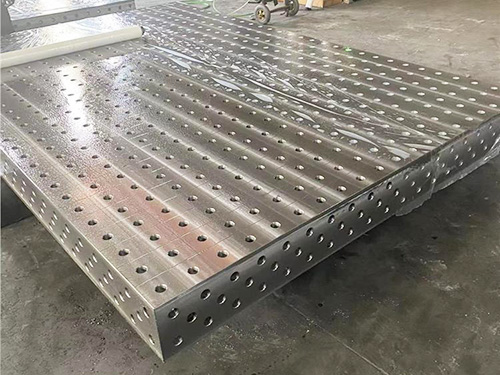
Ask two fabricators what matters most in a 3D welding platform and you will get two answers: precision and flexibility. Both are governed by one decision made before the table is ever ordered — the hole system. D28 (Ø28 mm bores on a 100 mm grid) and D16 (Ø16 mm bores on a 50 mm grid) are the two industry-standard grids, and picking the wrong one locks your shop into an accessory ecosystem that does not match its parts.
The Two Grids at a Glance
| Item | D28 Series | D16 Series |
|---|---|---|
| Bore diameter | Ø28.065 – Ø28.149 mm | Ø16.065 – Ø16.149 mm |
| Grid pitch | 100 ± 0.05 mm | 50 ± 0.05 mm |
| Verticality | 0.1 / 200 mm | 0.05 / 200 mm |
| Standard load | 2 t – 5 t | 2 t |
| Typical part scale | Large structural frames, chassis, machinery | Small precision assemblies, sheet-metal frames |
| Clamping force | High — rigid, heavy-duty | Moderate — fine positioning |
Why Bore Tolerance Is the Hidden Spec
Most buyers compare plate thickness and table size, but the spec that decides real-world accuracy is hole spacing tolerance. At ±0.05 mm across a 3-metre span, cumulative error stays inside what a robot welding cell can absorb; at looser tolerances, the fixture "fits" but the weld drifts. Insist on a calibration report tied to a coordinate measuring machine rather than a visual inspection certificate.
When D28 Is the Correct Choice
Heavy structural work: excavator arms, truck chassis, pressure-vessel fittings, marine structures.
Robotic welding lines: the rigid bore absorbs the reaction force of high-duty clamps and repeated part loading.
Long production runs: larger bores tolerate spatter and abuse better, reducing daily cleaning effort.
When D16 Wins
Small, fine-pitch parts: enclosures, brackets, aluminium frames and prototypes where 50 mm pitch gives meaningful positioning resolution.
Bench-scale and lab environments: research tables and teaching stations handling light workpieces.
Mixed manual stations: operators reposition clamps faster on a finer grid.
Material Still Matters More Than Grid
The grid decides compatibility; the material decides life. HT300 cast iron dampens vibration and holds flatness over years of thermal cycling, making it the default for inspection-adjacent welding work. Q355 steel offers higher impact toughness and suits tables that get moved or take shock loads. In both cases the working surface should be nitrided to HV 450–630 — this hardened layer is what stops spatter from welding itself into the bore walls.
Mixing Systems Without Buying Twice
Many workshops run one D28 platform as the heavy station and one D16 bench for fine work. Because both systems are standardized and serialized, accessories within each family remain interchangeable across batches and across suppliers — avoiding proprietary lock-in. If you already own a set of clamps in one system, order the matching grid and protect that investment.
FAQ
Q1: Can one table carry both D28 and D16 bores?
Yes, hybrid patterns can be machined to order, though most shops avoid it because mixed grids reduce clamping density in each system.
Q2: Do I need to ream the bores after heavy use?
Spatter build-up should be removed with a reamer or brush as part of routine maintenance; never grind the table surface.
Q3: Is a custom grid pitch possible?
Custom hole patterns, plate thickness, leg height and split designs are all available on a made-to-order basis.
Not Sure Which Grid Fits Your Parts?
Send a drawing and the heaviest workpiece weight to Hebei Haoxinran Machinery Manufacturing Co., Ltd (HXR Tools). Our engineering team will specify grid system, material, plate thickness and a matching fixture kit. Every platform is verified on a Swedish-imported 3D coordinate detector before shipment. Request a layout proposal.
 HOT PRODUCTS

 CONTACT US
—— E-mail:project@haoranmj.com
—— Whatsapp:+86 18932785670
—— Tel:+86 18932785670
—— Add:Across from Sanjing Distillery on Road 4, Botou Economic Development Zone, Cangzhou City, Hebei Province