







News Detail
Cast Iron Platform vs Granite Platform: Which Precision Base to Specify
author:hxrtools Time:2026-10-20 17:42:38 Click:161
Every measurement taken in a workshop is only as trustworthy as the reference it sits on. Choosing between a cast iron platform and a granite platform is therefore not a purchasing detail — it is a metrology decision. Granite delivers superior flatness and corrosion immunity but cannot be drilled or slotted economically; cast iron absorbs shock, accepts T-slots and threaded holes, and is the only realistic choice for layout, marking and fixture work. Understanding where each material wins prevents both over-specification and premature failure.
Head-to-Head Comparison
| Property | Cast Iron Platform (HT200–HT300) | Granite / Marble Platform |
|---|---|---|
| Typical grade | 0 – 3 (scraped) | 000 – 1 (lapped) |
| Wear resistance | Good, self-lubricating graphite | Excellent, no burr formation |
| Corrosion | Needs oiling / rust protection | Immune, non-rusting |
| Impact tolerance | High | Low — chips and cracks |
| T-slots, threaded holes, drilling | Fully machinable | Limited (inserts only) |
| Magnetic / burr behaviour | Magnetic, may pick up swarf | Non-magnetic, non-conductive |
| Best for | Layout, marking, welding, fixture base | Precision inspection, CMM rooms, calibration |
Why Cast Iron Still Dominates the Shop Floor
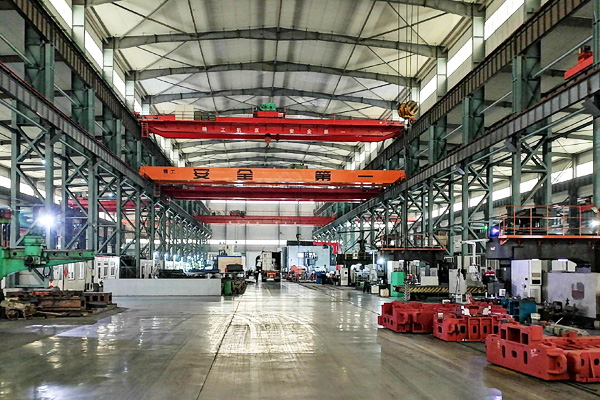
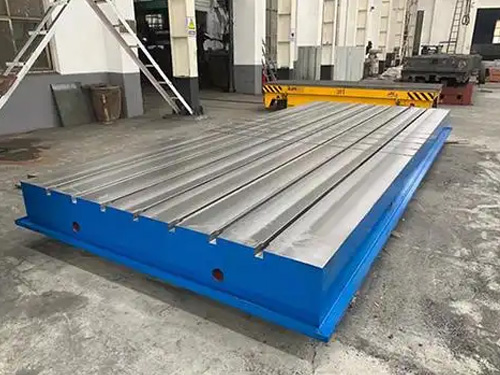
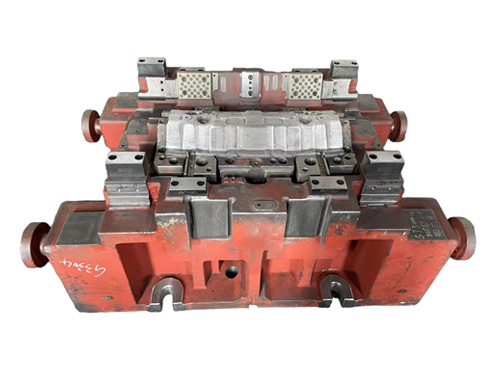
A quality cast iron platform is produced from resin-sand or cement-sand castings, then aged and vibration stress-relieved before finish machining. Casting method matters: resin-sand gives better surface integrity for large machine-tool and welding platforms, while cement-sand — used for roughly 80% of welding platforms — meets the technical parameters at lower cost. The working face is then hand-scraped to distribute load-bearing points, and can be machined with V-shaped, T-shaped or U-shaped grooves plus round and elongated holes.
That machinability is the decisive advantage. If your process requires clamping a workpiece down, you need T-slots or threaded holes, and that means cast iron.
Where Granite (Marble) Platform Is the Better Investment
Metrology rooms: grade 00 / 0 granite surface plates for calibration and CMM staging.
Corrosive or humid environments: granite never rusts and does not require oiling.
Fine-finish inspection: a dropped part on granite chips the stone but does not raise a burr that ruins every subsequent reading — a failure mode that quietly corrupts cast iron data.
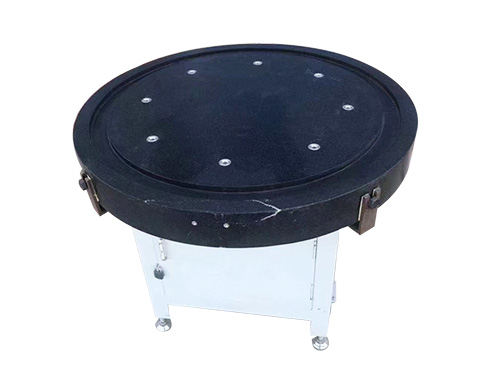
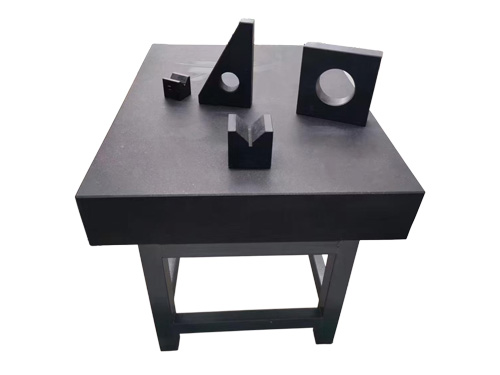
Special geometries: granite round platforms, V-blocks, straightedges, squares and structural components.
Flatness Grades: Read the Number Before You Buy
Handling, Care and Re-Calibration
Cast iron: brush off residual sand and burrs before first use, trim sharp edges, keep the surface oiled, and re-check flatness periodically — local deformation from improper loading is the most common cause of silent measurement error.
Granite: support on the designated three-point or multi-point stands, avoid point impacts at edges, clean with a non-oily stone cleaner, and rotate usage to prevent uneven wear.
Selection Checklist
Do you need to clamp, drill or T-slot? → Cast iron.
Do you need grade 00 flatness in a controlled room? → Granite.
Will the surface see weld spatter, dropped tools or shock? → Cast iron.
Is the environment humid, coastal or chemically aggressive? → Granite.
FAQ
Q1: Can a cast iron platform be resurfaced?
Yes. Worn cast iron surfaces can be re-scraped or re-machined and re-certified, which is a major lifetime-cost advantage over granite.
Q2: Are granite platforms available with holes?
Threaded inserts and custom drilling are possible but limited; for heavy clamping, specify a T-slotted cast iron platform instead.
Q3: What sizes can be supplied?
Both ranges are made to order, from bench-top plates to multi-metre inspection beds, with stands and covers available.
Specify the Right Base the First Time
Hebei Haoxinran Machinery Manufacturing Co., Ltd (HXR Tools) manufactures both ranges in-house — cast iron platforms, T-slot platforms, V-blocks, granite round platforms, marble structural parts — with Swedish CMM and blue-ray scanning verification. Tell us your required grade, size and clamping method and we will return a recommendation with a calibration report. Get a quotation.
 HOT PRODUCTS

 CONTACT US
—— E-mail:project@haoranmj.com
—— Whatsapp:+86 18932785670
—— Tel:+86 18932785670
—— Add:Across from Sanjing Distillery on Road 4, Botou Economic Development Zone, Cangzhou City, Hebei Province