







News Detail
3D Welding Platform for Robotic Welding Cells: Datum Accuracy Guide
author:hxrtools Time:2026-10-24 18:56:54 Click:158
A welding robot does not measure — it repeats. Every cycle it returns to coordinates taught against a physical datum, which means any drift in that datum becomes a drift in every weld. This is why automated cells fail in a distinctive way: good parts for weeks, then a batch of misplaced beads with no obvious change in the program. In most cases the robot is fine; the 3D welding platform underneath it has moved, worn, or was never built to hold a datum in the first place.
Why the Table Is the Real Datum of the Cell
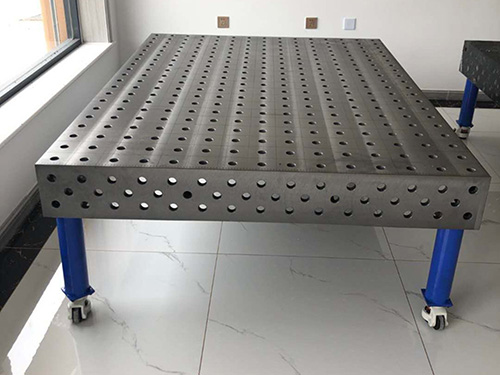
When a robot cell is commissioned, the operator teaches points relative to fixtures mounted on the table. If the fixture can shift by even a few tenths of a millimetre between loads, the torch path no longer matches the joint. A modular platform addresses this at three levels:
Precision bore geometry: D28 bores at Ø28.065–Ø28.149 mm with pitch held to 100 ± 0.05 mm, so a locating pin lands in the same coordinate every time.
Rigid structural body: HT300 cast iron or Q355 steel with reinforced legs, resisting both static load and the reaction forces of pneumatic clamps.
Nitrided surface: HV 450–630 hardness prevents spatter build-up in bores, the most common cause of slow, invisible datum drift.
Cell Integration Checklist
| Requirement | Recommended Specification |
|---|---|
| Repeatability target | Bore pitch ±0.05 mm; flatness 0.1/1000 mm |
| Material | HT300 cast iron (damping) or Q355 steel (impact) |
| Surface | Full nitriding, HV 450–630 |
| Load rating | 2 t standard, 5 t frame type; oversize on request |
| Levelling | Adjustable feet, M24 threaded, ±50 mm |
| Accessory interface | D28 quick clamps, angle brackets, locating pins, V-blocks |
| Mobility | Optional brake casters for reconfigurable cells |
Reducing Programming Time with Modular Fixturing
The second economic argument for a modular platform is programming. Because fixture geometry is built from standardized modules, a new part program can reuse previously verified clamp positions rather than starting from zero teach. Changeover becomes a mechanical reconfiguration task measured in minutes, not a re-teaching exercise measured in hours. For high-mix cells running dozens of part numbers, that difference dominates cell utilisation.
Applications That Benefit Most
Automotive chassis and sub-frames — high-volume, tight tolerance.
Agricultural machinery assemblies — large parts, moderate volume.
Elevator and conveyor components — repetitive frames with variant lengths.
Rail spare parts and pressure-vessel fittings — where traceability demands repeatable setups.
Solar mounting brackets and cabinet shells — batch welding with stable clamping precision.
Maintaining a Robotic Cell Datum
Re-check flatness on a scheduled interval with a calibrated level or CMM; document the result.
Clear bores after every production run — one spatter bead in a locating bore is enough to shift a part.
Never grind or hammer the working surface; both permanently alter the datum plane.
Rotate clamping locations so wear is distributed rather than concentrated at the robot's most-used zone.
FAQ
Q1: Can the platform be bolted directly to the robot base frame?
Yes. The rigid body is designed to be firmly fixed at robot stations and maintains stable benchmark coordinates during continuous operation.
Q2: Should I choose cast iron or steel for a robot cell?
Cast iron for maximum damping and thermal stability in fixed cells; steel where the table must be moved or absorb impact.
Q3: Do you supply the clamps as well?
Full fixture kits — clamps, angle brackets, locating pins, V-blocks and support blocks — are supplied with the platform and matched to your part drawings.
Build Your Cell on a Verified Datum
Hebei Haoxinran Machinery Manufacturing Co., Ltd (HXR Tools) supplies CE-verified 3D welding platforms, clamps and complete fixture kits, all inspected on Swedish-imported 3D coordinate and blue-ray scanning equipment. Send your workpiece drawings and cycle-time target — we will return a fixture layout that protects your robot's taught datum. Talk to our engineers.
 HOT PRODUCTS

 CONTACT US
—— E-mail:project@haoranmj.com
—— Whatsapp:+86 18932785670
—— Tel:+86 18932785670
—— Add:Across from Sanjing Distillery on Road 4, Botou Economic Development Zone, Cangzhou City, Hebei Province