







News Detail
How to Size a 3D Welding Platform: Dimensions, Thickness and Load Guide
author:hxrtools Time:2026-10-31 19:49:48 Click:61
Most 3D welding platform orders are specified backwards: the buyer picks a familiar size, then discovers the fixture overhangs the edge or the plate deflects under the heaviest job. Sizing is a five-variable problem — part envelope, plate thickness, material, hole system and load rating — and getting the order right means working through them in sequence rather than by habit.
Step 1 — Start From the Part Envelope, Not the Catalogue
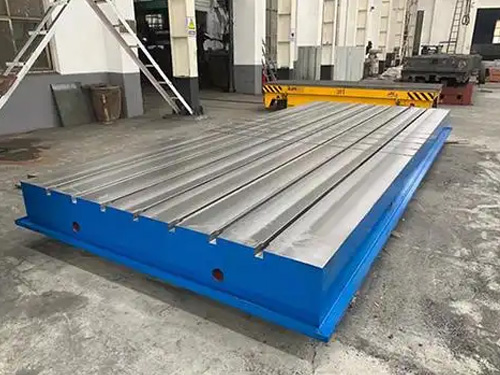
Take the largest workpiece diagonal, add clamp clearance on all sides, and add a working margin of at least 100 mm. Round up to the next standard grid multiple so clamps land on whole bore positions. Standard sizes include 1000×1000, 1200×1200, 1500×1000, 1500×1500, 2000×1000, 2400×1200 and 3000×1500 mm; any non-standard dimension can be produced to order.
Step 2 — Plate Thickness and Load Rating
| Duty | Recommended thickness | Typical load |
|---|---|---|
| Light fabrication, bench work | ~100 mm | Up to 1 t |
| General structural welding | 150 mm | 2 t standard |
| Heavy frames, machinery beds | 200 mm | 2 t – 5 t (frame type) |
| Oversize / custom beds | Designed to drawing | Engineered per project |
Thickness is not just strength — it is thermal mass. A thicker plate absorbs welding heat with less local distortion and holds flatness longer under repeated thermal cycling.
Step 3 — Material: HT300 Cast Iron or Q355 Steel
HT300 cast iron: excellent wear resistance, vibration damping and dimensional stability. The default choice where precision and stability matter, and where the table stays in one place.
Q355 steel: high strength and toughness, withstands larger and more shock-prone loads, and is lighter and more repairable. Choose it for portable stations or very large single-piece tops.
Step 4 — Hole System: D28 or D16
D28 uses Ø28.065–Ø28.149 mm bores on a 100 ± 0.05 mm grid — the right choice for heavy structural work and rigid, high-force clamping (including robot cells). D16 uses Ø16.065–Ø16.149 mm bores on a 50 ± 0.05 mm grid for fine-pitch, small-part work. If you already own tooling in one system, match it and protect that investment.
Step 5 — Surface, Legs and Accessories
Surface: full nitriding to HV 450–630 resists spatter burn-in and scoring.
Flatness: 0.1 / 1000 mm; verticality 0.1 / 200 mm; roughness Ra 3.2.
Working height: commonly 820–850 mm, custom heights available on request.
Levelling: adjustable feet are essential — an unlevelled table is the fastest route to permanent deformation.
Mobility: optional brake casters for flexible workshop layouts.
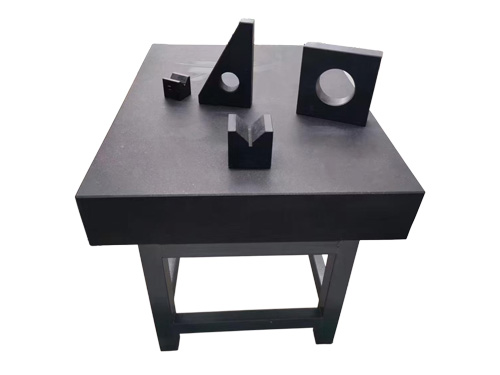
Accessories: budget for a complete kit — clamps, locating pins, angle brackets, V-blocks and support blocks.
Common Specification Mistakes
Sizing to the average part instead of the largest one.
Under-specifying load, then adding a heavy fixture later.
Ignoring levelling and floor condition.
Ordering the plate but only a token accessory set.
Failing to request a calibration report tied to CMM inspection.
FAQ
Q1: Can one table be split into sections and joined later?
Yes — split designs are available where workshop access or future expansion requires modular assembly.
Q2: What is the standard working height?
Typically 820–850 mm with adjustable levelling feet; custom heights are produced to order.
Q3: How long does a made-to-order platform take?
Lead time depends on size, material and casting schedule; contact us with your drawing for a confirmed schedule.
Send Your Drawing — We Will Size It For You
Hebei Haoxinran Machinery Manufacturing Co., Ltd (HXR Tools) has produced custom welding platforms since 2009 across a 90-acre Botou facility with 40+ CNC machines, Swedish CMM and blue-ray scanning inspection, and Norwegian high-frequency quenching. Send part dimensions, weight and process details for a specification and quotation. Get a specification.
 HOT PRODUCTS

 CONTACT US
—— E-mail:project@haoranmj.com
—— Whatsapp:+86 18932785670
—— Tel:+86 18932785670
—— Add:Across from Sanjing Distillery on Road 4, Botou Economic Development Zone, Cangzhou City, Hebei Province