







News Detail
Cast Iron Platform Flatness Grades and Hand Scraping Explained
author:hxrtools Time:2026-11-09 20:13:22 Click:187
Two plates can look identical on the shop floor and behave completely differently under a height gauge. The difference is not the paint or the thickness — it is the flatness grade and the way the working face was finished. Understanding how grades are defined, and why hand scraping still outperforms grinding on large cast iron surfaces, is what separates a platform that lasts a decade from one that quietly produces bad measurements within a year.
How Flatness Grade Is Actually Defined
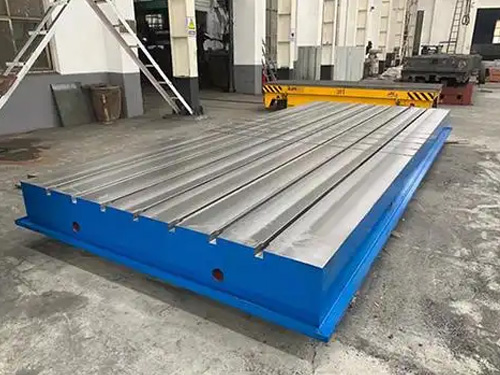
Flatness grade on a cast iron platform describes the total permissible deviation of the working surface from a true plane, measured across the full diagonal. This is the point most buyers get wrong: a grade is meaningless without the plate size attached to it. A grade 1 tolerance on a 630 mm plate and on a 3000 mm plate are very different numbers in millimetres, even though both carry the same label.
| Grade | Typical use | Relative cost |
|---|---|---|
| 000 / 00 | Calibration laboratory, gauge verification | Highest |
| 0 | Precision inspection, CMM staging | High |
| 1 | General inspection and precision layout | Moderate |
| 2 / 3 | Marking-out, welding fit-up, assembly | Economical |
Why Large Platforms Are Scraped, Not Just Ground
Machine grinding produces a visually perfect mirror finish, but on a large plate a mirror finish is a liability. It allows wringing — the gauge or workpiece sticks to the surface through an oil film — and it provides nowhere for air and oil to escape, which makes sliding a height gauge feel erratic. Hand scraping deliberately creates a controlled pattern of bearing points separated by shallow recesses. That pattern:
Establishes a statistically even load-bearing surface across the whole plate.
Retains a lubricant film so instruments slide smoothly without stick-slip.
Allows the surface to be re-established later — a ground plate that is worn is finished, a scraped plate can be re-scraped and re-certified.
What Degrades a Grade in Service
Point loading: concentrating heavy work in one area permanently deforms that zone.
Impact: hammering or dropping parts raises local high spots — and on cast iron (unlike granite) it can also raise a burr that ruins every reading taken over that spot.
Corrosion: rust pits are the fastest route from grade 1 to scrap.
Uneven support: a plate that is not level on correctly positioned stands will read out of grade even if the surface itself is perfect.
Uneven wear: using only the centre of the plate leaves the rest high.
Verifying and Re-Establishing Accuracy
Verification should be periodic and documented. Standard practice uses a precision level or electronic level on a defined grid, or a coordinate measuring machine for formal certification. Our own platforms are checked on a Swedish-imported three-dimensional coordinate detector and cross-checked with a Swedish blue-ray scanner before shipment, so the certificate reflects measured geometry rather than nominal intent.
FAQ
Q1: Can a worn cast iron platform be restored to its original grade?
Yes. Re-scraping or re-machining followed by re-certification can restore the original grade — one of the strongest lifetime-cost arguments for cast iron.
Q2: How often should flatness be checked?
Depends on duty: quarterly for a busy inspection plate, annually for a lightly used layout bed, and immediately after any impact event.
Q3: Does a finer surface finish mean a better grade?
No. A mirror finish can be worse in service than a correctly scraped surface because of wringing and oil-film behaviour.
Need a Certified Flatness Report?
Hebei Haoxinran Machinery Manufacturing Co., Ltd (HXR Tools) produces cast iron platforms from stress-relieved castings, finish-machined and hand-scraped in-house, then verified on Swedish-imported coordinate measuring and blue-ray scanning equipment. Send us your required grade and plate size for a specification and calibration report.
 HOT PRODUCTS

 CONTACT US
—— E-mail:project@haoranmj.com
—— Whatsapp:+86 18932785670
—— Tel:+86 18932785670
—— Add:Across from Sanjing Distillery on Road 4, Botou Economic Development Zone, Cangzhou City, Hebei Province