







News Detail
Welding Platform Installation, Levelling and Maintenance: A Practical Checklist
author:hxrtools Time:2026-11-12 20:42:08 Click:124
A precision platform does not arrive accurate and stay accurate — it is made accurate by the way it is installed. In our experience the majority of "the table is out of tolerance" complaints trace back to three installation errors: uneven support, no levelling procedure, and no baseline record. Get the first week right and the platform will hold its grade for years; get it wrong and no amount of re-scraping will fix the underlying cause.
Step 1 — Prepare the Floor and the Stands
Choose a location away from direct sunlight, heaters, doors and extraction outlets that create thermal gradients across the surface.
Ensure the floor can carry the point loads; a 3 m cast iron platform plus workpiece is a serious concentrated load.
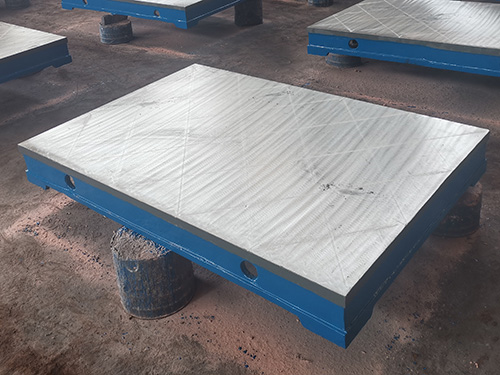
Use the matched stand supplied with the platform. Platforms are designed to be supported at defined points — improvised frames are the single most common cause of apparent flatness failure.
Step 2 — Level, Then Re-Level
Levelling is not a one-pass job. Adjust the feet in a cross pattern, check with a precision level along both axes and across both diagonals, then repeat. Critically, re-check after 24 hours and again after the first loaded week — stands and floors settle, and a table that was level on day one is often out by day seven.
Step 3 — Clean and Protect Before First Use
Remove all residual casting sand and machining burrs; left in place they degrade measurement accuracy immediately.
Brush off rust-prevention oil and any moisture-contaminated areas with a wire brush, then dress sharp edges.
Apply a thin, even film of anti-rust oil to the working surface, and keep it renewed.
Step 4 — Establish a Baseline Record
| Record item | Why it matters |
|---|---|
| As-delivered flatness map | Reference for every future check |
| Levelling readings (4 corners + centre) | Detects settling early |
| Serial number and certificate | Calibration traceability |
| Date of next scheduled check | Prevents drift being discovered too late |
Routine Maintenance Schedule
After every shift: clear spatter, iron filings and slag; wipe the surface dry.
Weekly: check bores on 3D platforms for spatter build-up; use a reamer or brush, never a grinder.
Monthly: verify levelling readings against the baseline.
Quarterly or annually: formal flatness verification depending on duty.
Before long idle periods: coat with anti-rust oil and fit a cover.
Operating Rules That Protect the Surface
Place workpieces down gently — never drop them onto the face.
Never hammer directly on the working surface; use a soft-faced mallet on the workpiece, never on the plate.
Do not grind, drill or weld fixtures onto the platform.
Rotate work across the whole surface so wear is distributed rather than concentrated.
FAQ
Q1: The plate reads out of tolerance straight after delivery — what now?
Check support and levelling first. Most apparent flatness failures disappear once the plate is correctly supported at its designated points and level across both diagonals.
Q2: Can the platform be moved after installation?
Yes, but re-level and re-verify afterwards. Treat every move as a fresh commissioning.
Q3: Should granite and cast iron be maintained the same way?
No. Cast iron needs oiling; granite must never be oiled, as an oil film attracts dust and alters gauge readings.
Commission Your Platform Correctly
Hebei Haoxinran Machinery Manufacturing Co., Ltd (HXR Tools) supplies cast iron platforms, 3D welding platforms and granite platforms with matched stands, levelling feet and protective covers. Contact our engineering team for an installation checklist tailored to your plate size and duty.
 HOT PRODUCTS

 CONTACT US
—— E-mail:project@haoranmj.com
—— Whatsapp:+86 18932785670
—— Tel:+86 18932785670
—— Add:Across from Sanjing Distillery on Road 4, Botou Economic Development Zone, Cangzhou City, Hebei Province