







News Detail
Controlling Welding Distortion with a 3D Welding Platform
author:hxrtools Time:2026-11-18 23:08:09 Click:168
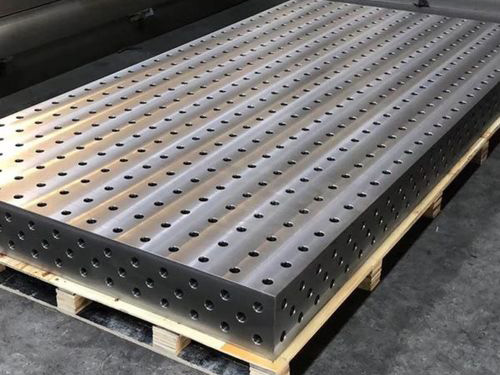
Welding puts heat into one side of a joint and takes it away unequally. The result — contraction that pulls the assembly out of alignment — is not a defect of the welder, it is physics. What separates shops that fight distortion with grinding and straightening from shops that prevent it is rigid, repeatable restraint. A 3D welding platform provides that restraint in a way a flat bench never can.
Why Distortion Happens
Uneven thermal expansion: the weld zone expands while the surrounding metal does not.
Contraction on cooling: the fused zone shrinks and pulls the plates toward the joint line.
Asymmetric restraint: if the part is free to move, it will move in the direction of least resistance.
Low section stiffness: thin plate and long members distort far more than short, stiff ones.
How a 3D Platform Reduces It
| Mechanism | Effect on distortion |
|---|---|
| Five-face clamping (top + 4 sides) | Restrains the workpiece in multiple directions, not just downward |
| Precision bore datum (100 ± 0.05 mm pitch) | Locates the part identically every cycle, so restraint is consistent |
| Heavy nitrided plate (HV 450–630) | Absorbs heat as thermal mass and resists local hot spots |
| Rigid cast iron body (HT300) | Damps vibration and resists deflection under clamp load |
| Fast reconfiguration | Makes correct fixturing economical on small batches too |
Practical Techniques on a Modular Table
Clamp close to the joint: restraint is most effective near the heat source.
Use stop pins as hard datum: pins in the bore grid define position without relying on friction.
Balance the weld sequence: alternate sides and use back-step or skip welding on long seams.
Add temporary support blocks: risers under long members prevent sag before it becomes permanent.
Tack in the fixture: tack the assembly while restrained, then complete the weld.
Allow controlled cooling: do not release clamps while the joint is still hot.
Material-Specific Notes
Mild steel: predictable contraction; symmetric restraint plus balanced sequencing is usually sufficient.
Stainless steel: higher expansion and lower thermal conductivity — expect roughly 50% more distortion than carbon steel and increase restraint accordingly.
Aluminium: high conductivity and high expansion, plus a soft surface; use greater clamp coverage and avoid over-tightening on finished faces.
Measuring Whether It Worked
Record first-piece dimensions, then check the last piece in the batch. If the spread is small, the restraint pattern is working. If parts progressively drift, the fixture is being released too early or clamp positions are inconsistent. Keeping a documented layout — bore coordinates and module list — makes this measurable rather than anecdotal.
FAQ
Q1: Can clamping too hard cause problems?
Yes. Over-restraint can crack a weld in high-carbon or highly restrained joints. The objective is consistent, symmetric restraint — not maximum force.
Q2: Does plate thickness of the table matter?
Yes. Thicker plates add thermal mass and stiffness, reducing local hot-spot distortion on the table itself.
Q3: Is this relevant for robot cells?
Especially so — the robot repeats coordinates, so any part movement shows up immediately as a misplaced bead.
Cut Rework at the Fixture Stage
Hebei Haoxinran Machinery Manufacturing Co., Ltd (HXR Tools) supplies D28 3D welding platforms with nitrided surfaces, matched clamps and fixture kits. Send your part drawings and distortion problem — our engineering team will propose a restraint layout.
 HOT PRODUCTS

 CONTACT US
—— E-mail:project@haoranmj.com
—— Whatsapp:+86 18932785670
—— Tel:+86 18932785670
—— Add:Across from Sanjing Distillery on Road 4, Botou Economic Development Zone, Cangzhou City, Hebei Province