







News Detail
3D Welding Platform for Construction Machinery Structural Parts
author:hxrtools Time:2026-11-21 23:42:38 Click:170
Excavator booms, loader buckets, crane jibs and press frames share one characteristic that breaks conventional welding setups: they are large, irregular, and every one is slightly different. Dedicated jigs are uneconomic at these sizes, and floor-based welding means constant re-handling and grinding. A 3D welding platform sized for structural work changes the economics of the whole job.
What Makes Construction Machinery Welding Difficult
| Challenge | Consequence without a proper platform |
|---|---|
| Large envelope (2–6 m members) | Work spills off the bench; joints welded out of position |
| High workpiece weight (hundreds of kg to tonnes) | Floor welding, crane handling, slow positioning |
| Irregular geometry | Custom supports improvised per job |
| Heavy sections and multi-pass welds | High heat input, significant distortion |
| Low volume, high variety | Dedicated jigs cannot be amortised |
Specifying a Platform for Structural Work
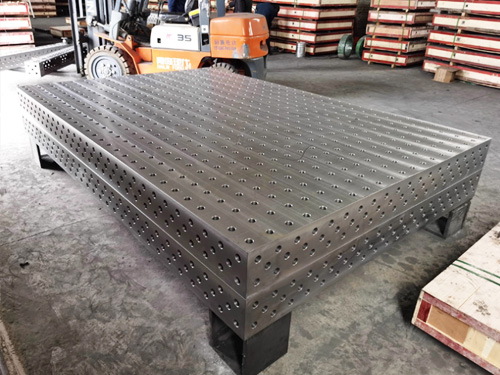
Size: start from the largest member diagonal plus clamp clearance — commonly 2000×1000, 2400×1200 or 3000×1500 mm, with larger custom beds available.
Hole system: D28 is the correct choice here — Ø28 mm bores on a 100 mm grid carry the reaction forces of heavy clamps.
Material: HT300 cast iron for damping and stability; Q355 steel where impact loading or mobility matters.
Thickness: 150–200 mm for heavy frames; thicker plate adds thermal mass against distortion.
Load rating: 2 t standard, 5 t frame type, engineered higher where required.
Surface: full nitriding to HV 450–630 — essential where multi-pass welding throws heavy spatter.
Fixturing Large Structural Members
Support blocks in graded heights: irregular castings and formed plate rarely sit flat; risers establish a level datum before clamping.
Angle brackets on the side faces: the four side faces of the platform let you clamp vertically, which is where a flat bench gives you nothing.
Stop pins as repeat datums: for batch work, pin the same bore positions every time and the assembly becomes repeatable.
V-blocks for round sections: pivot pins, cylinder barrels and tube members locate cleanly.
Typical Payback on This Work
Because one platform covers every member type, the fixture spend per new design drops to roughly zero after the initial kit. The larger gain is usually handling time: assembling, tacking and welding in one setup removes the crane moves and re-positioning that dominate floor-based structural welding.
Other Heavy Applications on the Same Platform
Agricultural machinery frames and implement assemblies.
Elevator metal components and guide structures.
Conveyor equipment frames and support steelwork.
Power cabinet shells and generator set bases.
Pressure vessel fittings and pipe spool assemblies.
FAQ
Q1: Can one platform handle both small brackets and 6 m frames?
Practically, most shops run two stations — a large D28 bed for structural work and a smaller bench for detail parts. Accessories remain interchangeable within the same hole system.
Q2: Is a split platform useful for large sizes?
Yes. Split designs solve workshop access limits and allow future extension by adding sections.
Q3: How is spatter managed on such heavy work?
Nitrided surfaces resist spatter burn-in; bores should still be cleared with a reamer or brush as routine maintenance.
Specify a Bed for Your Heaviest Work
Hebei Haoxinran Machinery Manufacturing Co., Ltd (HXR Tools) builds made-to-order D28 welding platforms up to multi-metre sizes in HT300 cast iron or Q355 steel, nitrided and verified on Swedish coordinate measuring equipment. Send your largest member dimensions and weight for a proposal.
 HOT PRODUCTS

 CONTACT US
—— E-mail:project@haoranmj.com
—— Whatsapp:+86 18932785670
—— Tel:+86 18932785670
—— Add:Across from Sanjing Distillery on Road 4, Botou Economic Development Zone, Cangzhou City, Hebei Province