







News Detail
Welding Platforms for Shipbuilding and Rail Transit Applications
author:hxrtools Time:2026-11-28 02:07:36 Click:125
Hull sections and rail car bodies are the two applications where a welding platform is stressed in every direction at once: enormous parts, heavy plate, thermally demanding welds, and tolerances that have to survive assembly of structures measured in tens of metres. The fixturing strategy that works here is not the same one that works on a bench-top bracket.
Shipbuilding: What the Platform Has to Survive
Curved plate: hull plates and shell sections rarely sit flat — support blocks and adjustable risers carry the load before any clamp is applied.
Long seams: continuous welds over metres of joint length accumulate contraction; balanced sequencing and consistent restraint matter more than clamp force.
Heavy sub-assemblies: frames, girders and foundation structures push toward the top of the load range — 2 t standard, 5 t frame type, engineered higher where needed.
Corrosive environment: salt air and humidity make surface condition a maintenance issue, not a cosmetic one.
Rail Transit: Precision Over Long Structures
| Requirement | Fixturing implication |
|---|---|
| Car body welding with tight assembly tolerance | Documented, repeatable bore-coordinate layouts |
| Bogie frames subject to fatigue loading | Consistent restraint to control distortion at stress-critical joints |
| Long components with multiple weld planes | Five-face clamping — side faces are essential |
| Traceability requirements | Recorded fixture layout and inspection reports per batch |
Platform Specification for These Sectors
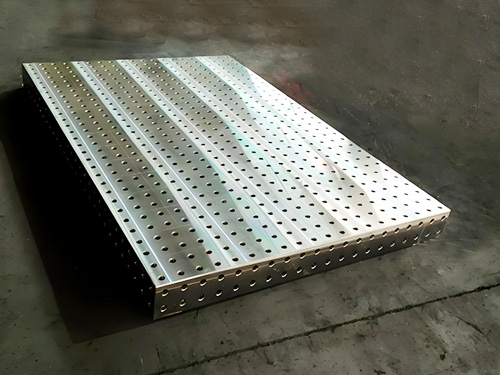
Hole system: D28 (Ø28.065–Ø28.149 mm bores, 100 ± 0.05 mm pitch) for heavy clamping.
Material: HT300 cast iron where damping and long-term stability lead; Q355 steel for impact-heavy or oversized beds.
Thickness: 150–200 mm to add thermal mass against long-seam heat input.
Surface: full nitriding, HV 450–630, to resist heavy spatter and salt-air corrosion.
Configuration: split or joined sections for very long assemblies; brake casters where stations must be reconfigured.
Sub-Assembly Strategy
Rather than welding an entire hull block or car body on one table, most yards build sub-assemblies on modular platforms and bring them together at a final assembly station. This is where modular fixturing pays off most: each sub-assembly gets a documented fixture layout, so a repeat order months later can be rebuilt identically without re-engineering.
Maintenance in Marine and Rail Environments
Clear spatter and debris after every shift; bores blocked by spatter silently destroy repeatability.
Renew anti-rust protection more frequently in coastal or humid conditions.
Re-check levelling after any relocation or heavy impact event.
Keep flatness records — in these sectors inspection evidence is often contractually required.
FAQ
Q1: Can platforms be joined to handle very long assemblies?
Yes. Split and joined configurations are manufactured to order, with matched grid alignment across sections.
Q2: Is nitriding necessary, or optional?
For heavy multi-pass welding and marine environments it is strongly recommended — it is the main defence against spatter burn-in and corrosion pitting.
Q3: Do you supply inspection documentation?
Platforms are verified on Swedish-imported coordinate measuring and blue-ray scanning equipment, and can be supplied with a flatness report.
Platforms Built for Marine and Rail Duty
Hebei Haoxinran Machinery Manufacturing Co., Ltd (HXR Tools) manufactures made-to-order D28 welding platforms with nitrided surfaces, split or joined configurations and documented inspection. Send your assembly dimensions and load requirement for a proposal.
 HOT PRODUCTS

 CONTACT US
—— E-mail:project@haoranmj.com
—— Whatsapp:+86 18932785670
—— Tel:+86 18932785670
—— Add:Across from Sanjing Distillery on Road 4, Botou Economic Development Zone, Cangzhou City, Hebei Province