







News Detail
3D Welding Platform vs 2D: Choosing the Right Flexible Fixturing System
author:hxrtools Time:2026-09-24 12:25:54 Click:195
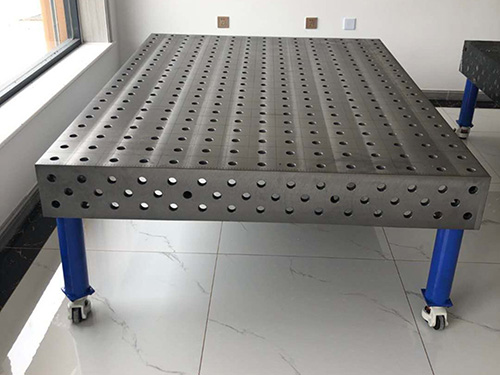
When a shop first hears about a 3D welding platform, a common question follows: is the extra dimension worth the extra cost, or is a simpler 2D welding platform enough? Both belong to the same family of flexible steel welding tooling, but they solve different problems. A 2D flexible welding platform gives you a precision hole-grid on the flat top only; a 3D welding platform extends that grid to all four sides, unlocking vertical and angular fixturing. This guide explains how each works, where each shines, the hole-grid standards involved, and how to choose the right system for your floor.
What Exactly Is a 3D Welding Platform?

A 3D welding platform is a precision-ground steel or stress-relieved cast-iron plate drilled with a regular pattern of boreholes on the top surface and on all four sides. Because the locating grid wraps around the table, you can build fixtures not only flat on top but also vertically and at angles, using the side faces as reference planes. This is what lets a single platform fixture a box frame, a sub-assembly with out-of-plane brackets, or a tubular structure that would be awkward on a flat-only surface.
The "3D" is not a marketing flourish—it is a literal description of usable reference geometry. Every borehole on every face is a potential anchor point tied to the same calibrated coordinate system, so a complex weldment can be located, clamped, and welded against a single true datum. For shops that build varied parts, that universality is the whole point of the platform.
In practice, a 3D platform is the foundation of a modular fixturing ecosystem: standardized locating pins, clamps, angle brackets, and stops drop into the grid and assemble into any fixture, then dismantle just as quickly. Nothing is welded to the platform; everything is reusable.
What a 2D Flexible Welding Platform Offers
A 2D flexible welding platform (often described as a two dimensional flexible steel welding tooling platform) provides the same precision hole-grid, but only on the flat top face. There are no locating holes on the sides, so fixturing is confined to the horizontal plane. For work that is essentially flat—plates, flat frames, layout, and tacking—this is perfectly adequate and noticeably cheaper.
The 2D platform still delivers the core benefit of flexible tooling: instead of cutting and scrapping a custom jig for every job, you assemble a reusable fixture from a kit of pins and clamps in minutes. The only thing it cannot do is build vertical or angled reference faces off the table sides. If your parts never need that, a 2D platform gives you 90% of the value at a lower price.
Many buyers start with a 2D platform and upgrade to 3D only when a recurring part family forces out-of-plane fixturing. That staged approach is sensible—buy the capability you actually use, and expand when the work demands it.
2D vs 3D: The Core Differences That Matter
The differences are easy to state but important to feel on the floor:
Grid coverage – 2D covers the top only; 3D covers top plus all four sides, multiplying usable anchor points.
Out-of-plane fixturing – 3D lets you build vertical walls and angled references; 2D cannot.
Versatility – 3D handles boxes, frames, and complex weldments; 2D is best for flat work.
Cost and weight – 3D platforms cost more and are heavier because of the added machining and ribbing on the sides.
Learning curve – 3D adds a little planning overhead (thinking in three axes); 2D is more intuitive for beginners.
These differences are not about quality—both can be made to the same flatness and bore tolerance—but about the envelope of parts each can fixture efficiently. Choose by the shape of your work, not by price alone.
Hole Grid Systems: 28 mm, 16 mm, and 100 mm Pitch
Whether you pick 2D or 3D, the hole grid is what makes the platform "flexible." Two standards dominate. The heavy-duty system uses a 100 mm top grid with 28 mm boreholes; a finer system uses a 50 mm grid with 16 mm boreholes for lighter sheet-metal and prototype work. The 100/28 system is the workhorse of structural and general fabrication because the larger bore resists the side loads of clamping.
The 28 mm bore supports robust locating pins that seat repeatably and shrug off weld heat; the 16 mm system allows tighter spacing for small parts but weaker pins. Commit to one pitch across your shop—mixing grid systems fragments your clamp and locator kit and erodes the repeatability that makes the platform worthwhile. A flexible 3D welding platform from a reputable maker states its pitch and bore tolerance explicitly.
When to Choose 2D vs 3D: A Decision Checklist
Are your parts mostly flat? If yes—plates, flat frames, layout, tacking—a 2D platform is enough and saves budget.
Do you build boxes, enclosures, or frames with vertical features? If yes, you need the side-grid of a 3D platform.
How often do out-of-plane fixtures recur? One-off angled parts can be jigged traditionally; a recurring family justifies 3D.
What is your training appetite? 2D is gentler for new operators; 3D rewards shops that invest in fixture planning.
What is your floor-space and budget reality? 3D platforms are heavier and costlier; size them to real need, not aspiration.
A useful rule of thumb: if you cannot remember the last time a part needed a vertical reference face, buy 2D and keep the savings. The moment vertical fixturing becomes routine, move to 3D.
Applications Best Suited to Each Platform
2D platforms excel in training schools, sheet-metal layout, flat-frame tacking, and job shops whose mix is dominated by planar work. They teach every fixturing concept without the complexity of side-grid planning, which is why many vocational programs standardize on them.
3D platforms earn their keep in structural steel sub-assemblies, machinery guards and frames, automotive prototypes, agricultural equipment, and any high-mix shop building three-dimensional weldments. Robotic cells also favor 3D platforms because the side-grid lets a single datum support multiple fixture programs. If your recurring work has depth, 3D is the right call.
Setup, Accuracy, and Maintenance for Both
The care story is the same for 2D and 3D. Keep boreholes free of spatter with a reamer or brush, apply light anti-rust oil to cast-iron tops, and periodically re-check flatness. Avoid grinding on the surface, and store clamps on a shadow board so the kit stays complete. For a 3D platform, also keep the side-grid bores clean—they are easy to forget and just as important as the top.
Accuracy comes from the platform itself, not from a purpose-built jig, so disciplined use of locating pins and a documented fixture layout give you repeatability that equals or beats hand-built tooling. With basic maintenance, a quality platform—2D or 3D—delivers accurate service for a decade or more.
Comparison Overview
| Factor | 2D platform | 3D platform |
|---|---|---|
| Grid location | Top face only | Top + all four sides |
| Best for | Flat plates, frames, layout | Boxes, frames, angled weldments |
| Out-of-plane fixturing | No | Yes |
| Typical cost | Lower | Higher |
| Training ease | Easier | Slightly more involved |
Frequently Asked Questions
What is the difference between a 2D and 3D welding platform?
A 2D platform has a precision hole-grid on the flat top only; a 3D platform extends the grid to all four sides, enabling vertical and angular fixturing. 3D is more versatile for complex assemblies.
Is a 2D welding platform cheaper than 3D?
Yes. A 2D platform requires less machining and lighter ribbing, so it costs less and is easier to handle, while still delivering flexible, reusable fixturing for flat work.
Can I upgrade from 2D to 3D later?
Many shops start with 2D and move to 3D when recurring out-of-plane parts demand it. Plan your grid pitch (e.g. 28 mm) so accessories stay compatible across the upgrade.
What hole pitch should I choose?
Use a 100 mm grid with 28 mm boreholes for heavy/structural work, or a 50 mm grid with 16 mm boreholes for lighter sheet-metal and prototypes. Commit to one pitch shop-wide.
Does a 3D platform improve weld accuracy?
Accuracy comes from the calibrated grid and disciplined use of locating pins; 3D does not add precision per se, but it lets you fixture complex parts accurately instead of forcing awkward workarounds.
Are the clamps and locators interchangeable between 2D and 3D?
If both share the same grid pitch and bore diameter (e.g. 28 mm), the same accessory kit works on top-grid holes of either; only the 3D side-grid is unique to 3D platforms.
Conclusion
Why HXR Tools for Your Workshop
Choosing between a 2D and 3D welding platform comes down to the shape of your work: flat-dominant shops save with 2D, while any shop building three-dimensional weldments gains speed and accuracy from 3D. Hebei Haoxinran Machinery Manufacturing Co., Ltd supplies both 2D flexible steel welding platforms and full 3D welding platforms with matching locator kits, all engineered to documented grid and flatness standards. Explore the 3D welding platform range or contact our fixture engineers for a layout matched to your parts.

Daniel Wright
 HOT PRODUCTS

 CONTACT US
—— E-mail:project@haoranmj.com
—— Whatsapp:+86 18932785670
—— Tel:+86 18932785670
—— Add:Across from Sanjing Distillery on Road 4, Botou Economic Development Zone, Cangzhou City, Hebei Province