







News Detail
3D welding platforms: what changes when you switch
author:hxrtools Time:2026-06-05 15:04:16 Click:128
Walk into any fabrication shop built before 2015 and you'll probably see the same setup: a flat steel table, maybe some C-clamps, and a wall of dedicated fixtures collecting dust. The 3D welding platform has been slowly changing that picture. Shops that made the switch tend to talk about it the way people talk about going from a flip phone to a smartphone—you don't go back.
What a 3D welding platform actually is
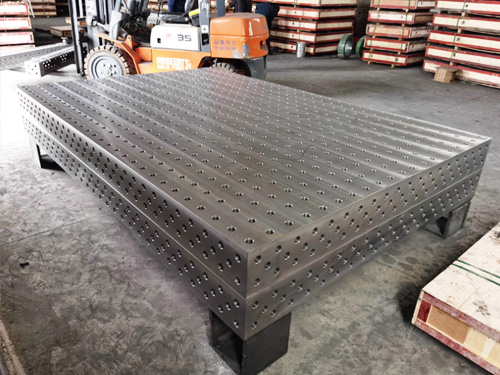
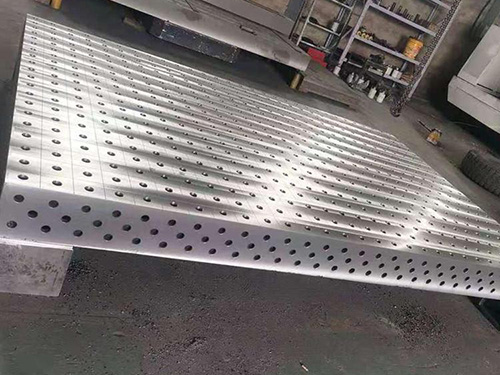
A 3D welding platform is a work surface with a machined grid of holes across the top and sides. Clamps, stops, and positioning accessories drop into those holes and lock in place. That's the whole concept, but the difference it makes is hard to overstate. You can clamp from five directions—top, both sides, both edges—instead of just pressing something down flat against a table.
The hole grid is usually spaced at 50mm or 100mm, and the holes themselves are machined to within about ±0.05mm. That level of precision means if you document your setup (which holes, which accessories, which orientation), anyone in the shop can recreate it and get the same result. For shops running small batches or frequent design changes, that repeatability matters more than raw welding speed.
The real advantages
Flexibility gets mentioned first, and for good reason. On a standard table, each new weldment often needs its own dedicated fixture. That fixture takes time to design, money to build, and floor space to store. On a 3D welding platform, you assemble a fixture from modular parts in 15 to 30 minutes, then take it apart when you're done. No storage problem. No obsolete fixtures piling up.
Precision is the second big gain. When holes are positioned to ±0.05mm and your accessories fit snugly, the workpiece goes where you want it every time. That consistency shows up in fewer out-of-tolerance parts and less rework.
Five-sided access sounds like a marketing bullet point until you've spent an hour repositioning a heavy frame on a flat table because the weld joint was on the wrong face. With side clamping, you just rotate the clamping point, not the workpiece.
Where these platforms get used
Automotive shops use them for prototype chassis and small-batch sub-assemblies. The modular setup means you don't need a permanent fixture for something you might only build 20 of. Construction equipment fabricators like them for structural frames and lifting lugs—parts with awkward geometries that don't sit flat on their own. Aerospace applications are more about the precision: when tolerance stack-up has to be tightly controlled, the repeatability of a 3D welding platform is worth paying for.
Buying considerations
Size is the obvious first question. Measure your largest typical workpiece, add some margin for clamping, and check your floor space. Tables range from 1000×1000mm up to 4000×2000mm. Going too small is a common mistake—you end up doing half your assemblies off the table anyway.
Hole spacing comes down to what you're building. 100mm spacing works for large structural assemblies. 50mm gives you finer positioning for smaller, tighter-tolerance work. The trade-off is that finer spacing costs more to manufacture.
Load capacity matters more than people think. You need to account for the workpiece weight plus clamping forces plus whatever the welder leans on it. Heavy-duty platforms from a reputable manufacturer handle 10+ tons. Lighter-duty ones will deflect under that kind of load, and deflection kills accuracy.
Surface treatment options include bluing, hard chrome plating, and nitriding. For most shops, bluing is fine. If you're working in a humid environment or near saltwater, spend the extra on chrome plating.
Does the math work out?
The upfront cost of a 3D welding platform runs higher than a standard welding table. Most shops that track their numbers find it pays for itself within a year. The savings come from not building dedicated fixtures, faster setups, less rework, and reclaiming the floor space that was used for fixture storage. For job shops with high product mix, the fixture savings alone often cover the investment.
References
ISO 13920:1996. Welding - General tolerances for welded constructions.
AWS D1.1:2020. Structural Welding Code - Steel.
Welding Fixture Design Principles. American Welding Society Technical Resources.
Modular Fixturing Systems for Welding. Manufacturing Engineering Handbook, McGraw-Hill.
OSHA Standards for Welding, Cutting, and Brazing - 29 CFR 1910.252.
 HOT PRODUCTS

 CONTACT US
—— E-mail:project@haoranmj.com
—— Whatsapp:+86 18932785670
—— Tel:+86 18932785670
—— Add:Across from Sanjing Distillery on Road 4, Botou Economic Development Zone, Cangzhou City, Hebei Province