







News Detail
Cast Iron Surface Plates: The Foundation of Precision Metrology
author:hxrtools Time:2026-09-26 12:44:59 Click:57
In precision manufacturing, every accurate measurement starts from a flat, stable reference. A cast iron surface plate (also called a cast iron platform or surface table) provides exactly that foundation for inspection, scribing, and assembly. This article explains grades, finishes, accessory families, and how cast iron plates compare to other reference surfaces.
What Is a Cast Iron Surface Plate?

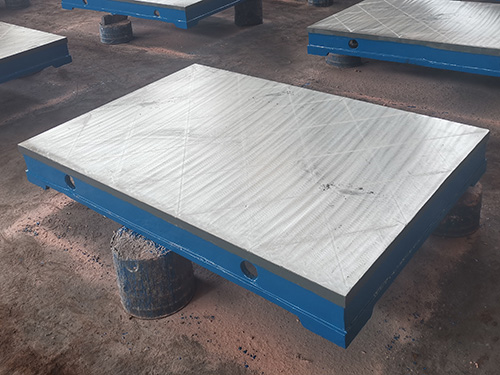
A cast iron surface plate is a rigid, precisely flattened plate used as a datum for measuring, marking out, and checking workpiece flatness. Made from dense cast iron (commonly HT250/HT300), it is stress-relieved to stabilize the structure and then hand-scraped or precision-ground to a defined flatness grade.
Its job is unglamorous but critical: provide a surface so trustworthy that every measurement taken against it can be trusted. Without a certified plate, inspection becomes guesswork and assemblies drift out of tolerance.
Accuracy Grades
Surface plates are classified by flatness tolerance. Typical grades run from coarse workshop grade through inspection and laboratory grades, with tighter tolerances for higher precision. Always match the grade to the task: a layout bench does not need laboratory accuracy, but a calibration room does.
Grade selection also affects cost. Specifying a laboratory-grade plate for a general fitting bench wastes budget; specifying a workshop grade for calibration invites bad data. The right match is a deliberate engineering choice.
Scraped vs Ground Finish
Hand-scraping creates a pattern of bearing points that improves oil retention and wear, favored for high-accuracy plates. Precision grinding is faster and economical for coarser grades. A quality cast iron working platform will specify its finishing method.
Scraping is also self-revealing: the spotted pattern shows exactly where high and low spots lie, letting a skilled hand converge on a true plane. That is why the finest plates are still scraped by hand even in an age of CNC grinding.
Common Forms and Accessories
Box-type plates – ribbed hollow bodies for stiffness without excess weight.
T-slot plates – for fixturing during inspection or assembly.
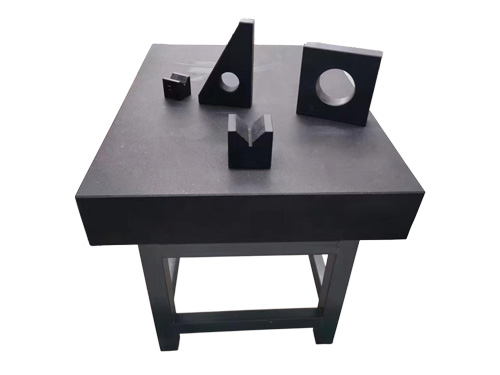
Angle plates and parallels – to reference vertical and offset faces.
V-blocks – to support shafts and round work for checking.
Straight edges and squares – to transfer the datum to other surfaces.
Together these form a complete inspection workstation built around one trusted plane.
Cast Iron vs Granite Reference Surfaces
Cast iron excels where you need a magnetic or clampable steel surface and good impact resistance; granite (see our granite platform) wins for thermal stability and corrosion resistance in clean inspection rooms. Many labs keep both, using cast iron for shop-floor layout and granite for the climate-controlled metrology room.
Calibration and Records
An uncalibrated plate is just a heavy slab. Establish a schedule—annual for normal use, semi-annual for critical use—and keep records. Re-scrape if flatness drifts. A calibration certificate tied to national standards is what turns a plate into legal metrological evidence.
Rust Protection and Handling
Apply a thin oil film, store covered, and wipe condensation. Avoid acidic or salty environments, and never stand tools on the edge where chipping starts. With care, a cast iron plate outlasts the career of the inspector who first used it.
Comparison Overview
| Grade | Typical use | Flatness tolerance |
|---|---|---|
| Workshop (coarse) | General layout, fitting | Largest |
| Inspection | Production inspection | Medium |
| Laboratory | Calibration, metrology | Tightest |
Frequently Asked Questions
How often should a cast iron surface plate be re-calibrated?
In normal use, annual verification is common; high-use or critical plates may need semi-annual checks. Record results and re-scrape if flatness drifts.
Why is stress relief important?
Casting and machining leave internal stresses that cause slow distortion. Stress relief stabilizes the plate so its flatness holds for years.
Can I use a welding table as a surface plate?
Only if it is precision-milled and graded; a raw welding top is not a substitute for an inspection-grade plate.
How do I protect a cast iron plate from rust?
Apply a thin oil film, store covered, and wipe condensation. Avoid acidic or salty environments.
What size plate do I need?
Larger than your largest inspected part plus gauge clearance; common sizes range 300×400 mm to 2000×4000 mm.
Is a box section better than a solid plate?
Box sections give high stiffness at lower weight and cost, and are standard for larger plates; solid plates suit small, heavily loaded benches.
Conclusion
Why HXR Tools for Your Workshop
A properly graded, stress-relieved cast iron surface plate is the quiet backbone of quality control. Hebei Haoxinran Machinery Manufacturing Co., Ltd produces cast iron platforms, inspection tables, and V-blocks to documented flatness grades. View cast iron platforms or contact us to specify the right grade and size.

James Carter
 HOT PRODUCTS

 CONTACT US
—— E-mail:project@haoranmj.com
—— Whatsapp:+86 18932785670
—— Tel:+86 18932785670
—— Add:Across from Sanjing Distillery on Road 4, Botou Economic Development Zone, Cangzhou City, Hebei Province