







News Detail
Cast Iron vs Alternative Materials for Welding Platforms: A Comprehensive Comparison
author:hxrtools Time:2026-07-23 17:02:02 Click:131
Material selection for a welding platform is one of the most consequential decisions in the purchasing process, yet it is often treated as an afterthought by buyers focused on dimensions and price. The material from which a platform is constructed determines its vibration dampening characteristics, flatness retention over time, thermal behavior, weight, cost, and the types of finishing and maintenance it requires. Understanding the properties and trade-offs of cast iron compared to the primary alternative materials helps buyers make choices that optimize long-term value rather than minimizing initial purchase price.
The Case for Cast Iron
Cast iron has dominated precision workholding and surface plate applications for over a century, and its continued prevalence in high-quality welding platforms reflects genuine material advantages rather than mere tradition. The graphite flake structure within grey cast iron provides excellent vibration dampening, absorbing harmonic energy from welding operations that would otherwise propagate through the platform and potentially affect weld quality and operator comfort. This dampening characteristic is particularly valuable in automated and semi-automated welding environments where arc stability directly influences bead quality.
Cast iron surfaces can be machined and ground to exceptional flatness tolerances, and they retain those tolerances remarkably well under heavy use. When surface wear does eventually require attention, cast iron responds well to grinding and resurfacing processes that restore original flatness without requiring full platform replacement. A quality cast iron platform maintained with regular cleaning and periodic resurfacing can serve a fabrication shop reliably for several decades, making the initial investment a long-term asset rather than a recurring expense.
The high mass density of cast iron contributes to platform stability in a way that lighter materials cannot match. A heavier platform resists displacement during welding operations, reducing vibration that can affect weld quality and creating a more stable reference for workpiece positioning. This stability advantage becomes most apparent during heavy welding operations on large workpieces where lighter platforms might show measurable deflection under load.
Fabricated Steel: The Cost-Conscious Alternative
Fabricated steel welding platforms—constructed from welded steel plate and structural sections rather than castings—offer meaningful advantages in specific application areas that make them worth considering alongside cast iron options. The most significant advantage is cost: steel fabrication eliminates the pattern-making, molding, and foundry operations required for cast iron production, resulting in lower manufacturing costs that can be passed to the buyer.
Fabricated steel platforms are generally lighter than equivalent cast iron constructions, which simplifies installation and handling in facilities where floor loading is a concern or where the platform must be repositioned periodically. For mobile or portable welding applications, this weight advantage may be decisive. Steel platforms also offer greater design flexibility, as complex geometries, integrated features, and custom configurations are more readily achieved through fabrication than casting.
However, steel platforms have meaningful limitations. Steel does not dampen vibration as effectively as cast iron, which can result in increased harmonic interference during precision welding operations. Welded fabrication joints in the base structure can develop fatigue cracks over extended use under cyclic loading. And unlike cast iron, which can be resurfaced multiple times, a fabricated steel platform approaching the end of its surface life may require complete replacement rather than economical restoration.
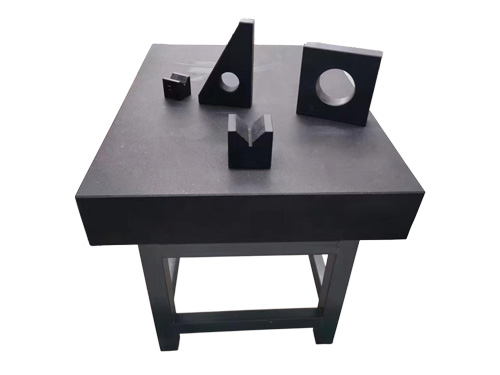
Granite Surface Plates: Precision Beyond Metal
Granite platforms occupy a specialized niche in the welding platform market, reserved for applications where the dimensional stability advantages of natural stone outweigh its practical limitations. The most significant advantage of granite is its near-zero thermal expansion coefficient, which allows the platform to maintain calibrated flatness in environments with significant temperature variation—a scenario where even high-quality cast iron will exhibit measurable dimensional changes.
Granite surfaces resist surface wear from workpiece contact and repeated fixture placement better than cast iron, maintaining their precision without the need for regular surface treatment. They are completely immune to the surface rusting that afflicts ferrous platforms in humid environments, simplifying maintenance in facilities without climate control or in outdoor installations.
The limitations of granite are significant for most fabrication applications. Granite is brittle and vulnerable to impact damage—a dropped workpiece or heavy clamp can chip or crack the surface, potentially rendering it unusable. Granite platforms are also considerably heavier than equivalent metal platforms, complicating installation and support requirements. And the initial cost of precision granite platforms typically exceeds that of quality cast iron equivalents by a substantial margin.
Aluminum and Non-Ferrous Platform Materials
Aluminum welding platforms appear occasionally in applications where weight reduction is a critical priority, such as portable field fabrication equipment or installations where floor loading constraints prohibit heavier alternatives. Aluminum offers the advantage of non-marring surfaces that will not damage sensitive workpieces, and its natural oxide layer provides corrosion resistance without protective coatings.
However, aluminum's material properties make it poorly suited for most welding platform applications. Aluminum's thermal conductivity is approximately three times that of steel, meaning it conducts welding heat away from the immediate area far more rapidly—a characteristic that affects weld cooling rates and potentially compromises weld quality in procedures developed assuming ferrous base materials. Aluminum surfaces scratch and dent more easily than cast iron, and aluminum platforms cannot be magnetic-clamped, limiting fixture options in workshops relying on magnetic positioning systems.
Specialty non-ferrous platform materials such as hardened tool steel inserts or ceramic surface plates serve niche applications in research, metrology, and advanced manufacturing environments where specific material properties justify the additional cost and operational constraints they impose. For the vast majority of general and heavy fabrication applications, these specialty materials do not offer compelling advantages that justify their premium pricing.
Selecting the Right Material for Your Application
The optimal material choice depends on which properties matter most for your specific operation. General fabrication shops serving diverse markets benefit most from cast iron's combination of performance, durability, and long-term value. Shops focused on precision measurement and inspection in temperature-variable environments may find granite's thermal stability decisive despite its other limitations. Portable or field operations may prioritize steel fabrication's lower weight and easier handling.
Consider not just your current requirements but your expected operational trajectory. A growing shop that anticipates increased precision requirements over the next five years may benefit from investing in cast iron or granite platforms now rather than facing an equipment transition later. A stable operation with well-defined requirements may find that a lower-cost steel platform delivers adequate performance for its actual needs.
Discuss material options with your platform manufacturer, who can explain how different material choices translate into performance differences in your specific operating environment. The time invested in understanding material properties before purchase pays dividends through better equipment decisions that serve your operation well for years after the purchase is made.
References:
Davis, J. R. (Ed.). (2001). Cast Irons (2nd ed.). Materials Park, OH: ASM International.
Callister, W. D., & Rethwisch, D. G. (2018). Materials Science and Engineering: An Introduction (10th ed.). Hoboken, NJ: Wiley.
Degarmo, E. P., Black, J. T., & Kohser, R. A. (2019). Materials and Processes in Manufacturing (12th ed.). Hoboken, NJ: Wiley.
 HOT PRODUCTS

 CONTACT US
—— E-mail:project@haoranmj.com
—— Whatsapp:+86 18932785670
—— Tel:+86 18932785670
—— Add:Across from Sanjing Distillery on Road 4, Botou Economic Development Zone, Cangzhou City, Hebei Province