







News Detail
Granite Surface Plates for Precision Inspection: Why They Outperform Metal
author:hxrtools Time:2026-09-28 13:51:55 Click:139
When the environment demands thermal stability, corrosion resistance, and zero rust, a granite surface plate outperforms metal alternatives for precision inspection. Natural granite—often called marble in the trade—provides a dimensionally stable datum that does not react with coolants or air. This guide covers why granite wins, how grades work, the product family, and care practices.
Why Granite for Precision Inspection?

Granite is naturally hard, non-magnetic, and immune to rust. Its low thermal expansion means a granite plate stays flat through normal temperature swings that would flex a steel plate. It also dampens vibration and resists chipping better than many expect, making it ideal for metrology rooms and CMM labs.
Because it neither rusts nor magnetizes, granite is the safe choice wherever coolant, humidity, or sensitive instruments are present. A steel plate in the same room might quietly corrode or attract ferrous debris; granite simply sits there, stable.
Accuracy Grades and Standards
Granite plates follow national standards (e.g. GB/T 4987 for flat plates) with grades such as 000, 00, 0, 1, 2, 3, where 000 is the tightest. Choose grade 00 or 000 for calibration, grade 0/1 for inspection, and grade 2/3 for workshop layout. A granite platform should ship with a calibration certificate.
Grade is not a marketing label—it is a measured flatness deviation. Always request the actual calibration report so you can trace the plate's accuracy to the standard it claims to meet.
Shapes Beyond the Flat Plate
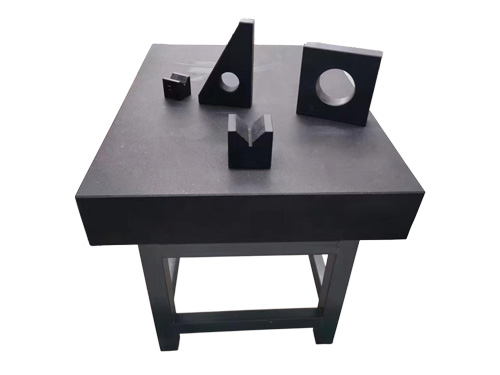
Granite square rulers – for checking right angles.
Granite V-shaped frames – to support and inspect round work.
Granite square boxes – 90° referencing for setups.
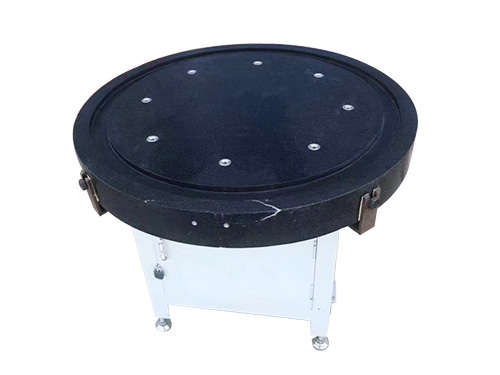
Granite round platforms – rotary and angular inspection bases.
Marble structural components – stable bases for machines and optics.
These accessories extend granite's stability into every orientation an inspector needs.
Granite vs Cast Iron: The Real Differences
The trade-off is impact and magnetism. Granite will not rust and is thermally superior, but it is brittle under sharp impact and cannot hold a magnet. Cast iron shrugs off knocks and clamps magnetically but needs oiling and can warp if not stress-relieved. Match the material to the room and the task.
Where Granite Plates Excel
Coordinate measuring machine labs, optical inspection, semiconductor equipment bases, and any clean environment where rust or thermal drift would corrupt data. The marble structural components made from the same stone also serve as vibration-isolating bases for sensitive instruments.
Certification and Traceability
Reputable makers provide a calibration report tracing flatness to national standards, often with laser or autocollimator measurement. For regulated industries, that traceability is as important as the plate itself—it is the paper that makes a measurement defensible.
Care and Handling
Keep the plate clean with a soft cloth and mild cleaner, avoid dropping tools, and store it supported on its designed feet. Because granite does not rust, maintenance is mostly about keeping the surface free of abrasive grit that could scratch it. Never slide heavy parts across the face—lift and place.
Comparison Overview
| Property | Granite | Cast iron |
|---|---|---|
| Rust | None | Needs oiling |
| Thermal stability | Excellent | Good |
| Magnetism | None | Magnetic |
| Impact resistance | Good | Very good |
| Cost (large) | Moderate | Higher |
Frequently Asked Questions
What granite grade do I need for a CMM lab?
Grade 00 or 000 is typical for coordinate measuring rooms; grade 0 suits general inspection. Match the plate grade to your equipment's accuracy.
Do granite plates ever need re-calibration?
Yes—periodically, especially if moved. Granite is stable but handling and support changes can affect flatness; verify annually in critical use.
Can granite replace a cast iron welding table?
No. Granite is for inspection, not welding; heat and impact from welding would damage it. Use a welding table for fabrication.
Why are granite components used in machines?
Their dimensional stability and vibration damping make them ideal bases for optical, semiconductor, and precision measuring equipment.
How are granite plates certified?
Reputable makers provide a calibration report tracing flatness to national standards, often with laser or autocollimator measurement.
Is 'marble' the same as 'granite' here?
In industry, both terms refer to natural stone reference plates; granite is the more common and harder choice for precision work.
Conclusion
Why HXR Tools for Your Workshop
For inspection environments where stability and corrosion resistance matter, granite surface plates are hard to beat. Hebei Haoxinran Machinery Manufacturing Co., Ltd supplies granite platforms, square rulers, V-frames, and custom marble components with calibration certificates. Explore granite platforms or reach our team for grade selection.

Hannah Schmidt
 HOT PRODUCTS

 CONTACT US
—— E-mail:project@haoranmj.com
—— Whatsapp:+86 18932785670
—— Tel:+86 18932785670
—— Add:Across from Sanjing Distillery on Road 4, Botou Economic Development Zone, Cangzhou City, Hebei Province