







News Detail
Granite or cast iron: which measurement surface actually works better?
author:hxrtools Time:2026-06-14 19:42:43 Click:96
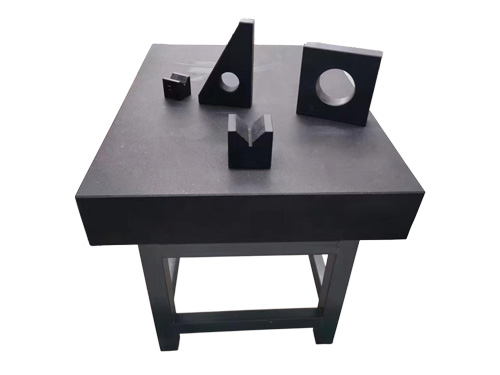
This debate has been running for decades, and the answer hasn't changed: it depends on what you're doing. Granite surface plates and cast iron platforms are both good at their jobs. They're just different jobs.
The material differences that matter
Thermal expansion is the headline number. Granite expands at roughly 4.5 to 5.5 × 10⁻⁶/°C. Cast iron comes in around 10 to 11 × 10⁻⁶/°C. That's roughly a 2:1 ratio. If your lab temperature swings even a couple degrees, the granite surface plate moves half as much. For precision work, that's a real advantage.
Vibration damping goes the opposite direction from what most people expect. Cast iron is famous for damping vibration in machine tools, and it does a good job. But granite actually dampens high-frequency vibrations better. That's why you see granite under coordinate measuring machines and optical comparators—those instruments are sensitive to high-frequency vibration that cast iron doesn't catch as well.
Hardness: granite runs 6-7 on the Mohs scale, cast iron around HB170-241 Brinell. Granite resists scratching better. Cast iron develops a protective oxide layer that contributes to long-term durability in its own way.
Where granite wins
No rust. This is bigger than it sounds. Cast iron platforms need regular oiling and careful storage. A granite surface plate sits there and doesn't corrode, even in humid environments. That's one less maintenance task and one fewer way to damage the surface.
Non-magnetic. If you use magnetic-base indicators (and most QC departments do), granite won't interfere. Cast iron can pull on magnetic bases enough to affect positioning on sensitive setups.
Zero internal stress. Cast iron holds residual stresses from the casting process. Over years, those stresses can cause slow warping. Granite doesn't have this problem—once it's machined flat, it stays flat. A granite surface plate from a competent supplier won't drift from internal stress relief.
Wear uniformity. Because granite has consistent hardness across the whole surface, it wears evenly. Cast iron can have hard and soft spots, leading to uneven wear patterns over time.
Where cast iron wins
Repairability. This is cast iron's trump card. When a granite plate wears past tolerance, you buy a new one. When a cast iron plate wears, you have it rescraped or reground. It comes back to spec and keeps working. Over a 20-year span, that repairability often makes cast iron cheaper despite the maintenance overhead.
Load capacity. For a given size, cast iron carries more weight. If you're putting heavy workpieces on it—engine blocks, large castings, structural assemblies—cast iron handles the load with less deflection.
T-slots and features. Cast iron can be cast with integral T-slots, threaded holes, and other workholding features. Granite can't. If you need to clamp things to your plate, cast iron gives you options that granite simply doesn't.
So which one?
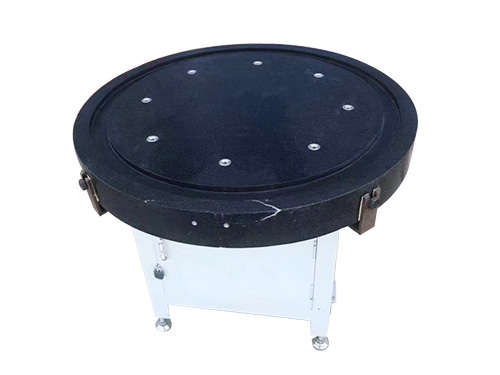
Use a granite surface plate if your primary job is measuring things, the room temperature isn't perfectly controlled, rust is a concern, or you're working in a cleanroom. Use cast iron if you need to support heavy parts, do welding or machining on the same surface, want T-slot mounting, or plan to resurface the plate in the future.
Plenty of shops end up with both—a granite plate for inspection and a cast iron table for fabrication work. That's not indecision. That's having the right tool for each job.
References
ISO 8512-2:2008. Surface plates - Part 2: Granite.
ISO 8512-1:2008. Surface plates - Part 1: Cast iron.
Fed Spec GGG-P-463c. Federal Specification for Surface Plates (Granite).
ASME B89.3.7. Surface Plate Calibration.
Rock Properties and Their Application in Precision Metrology. International Journal of Rock Mechanics and Mining Sciences.
 HOT PRODUCTS

 CONTACT US
—— E-mail:project@haoranmj.com
—— Whatsapp:+86 18932785670
—— Tel:+86 18932785670
—— Add:Across from Sanjing Distillery on Road 4, Botou Economic Development Zone, Cangzhou City, Hebei Province