







News Detail
Modular 3D Welding Tables: Why They Are Transforming Modern Fabrication Shops
author:hxrtools Time:2026-10-02 17:31:20 Click:52
Fabrication shops that build varied, low-volume weldments face a familiar problem: every new job means cutting, grinding, and welding custom jigs that are thrown away after one use. A modular 3D welding table removes that waste by giving you a reusable, hole-gridded steel surface where clamps, angles, and stops snap into place in minutes. This guide explains how modular 3D welding platforms work, the grid standards you should know, the components involved, and how to choose the right system for your floor.
What Is a Modular 3D Welding Table?

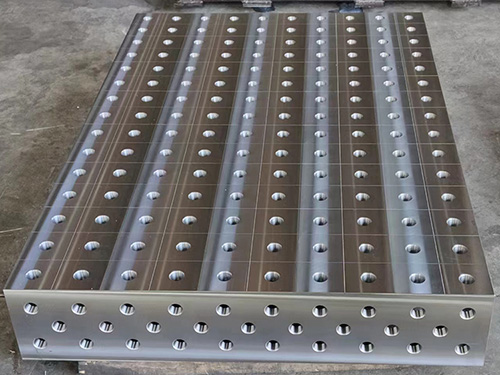
A modular 3D welding table (also called a 3D welding platform or flexible welding fixture table) is a precision-ground steel plate drilled with a regular pattern of boreholes—typically on a 100 mm grid on top and 50 mm on the sides—so components can be located and clamped in three dimensions. Unlike a fixed welding bench, every hole is a potential anchor point, which means one table replaces dozens of single-purpose fixtures.
The "3D" refers to the fact that you can build fixtures not just on the flat top but also on all four sides of the table, creating vertical and angular reference faces. This is what lets a shop fixture a complex frame, a bracket cluster, or a tubular sub-assembly on the same piece of equipment. The underlying principle is simple but powerful: make the reference surface universal, and let standardized accessories do the fixture-building.
Because the accuracy comes from the table itself rather than from a purpose-built jig, the same investment keeps paying dividends across every new part you take on. That is why modern job shops, training centers, and even aerospace subcontractors have adopted modular tables as their default fixturing base.
Core Components of a 3D Welding Platform
A complete modular system is more than a drilled plate. The ecosystem around the table is what makes it productive. The main building blocks include:
Table top – the drilled and stress-relieved steel or cast-iron plate that defines accuracy and load capacity.
Locating pins and bushings – quick-release inserts that drop into boreholes to position parts with repeatable offset.
Clamps and stops – hold-downs, vertical and horizontal clamps, and adjustable stops that lock the workpiece.
Angle brackets and supports – build vertical and angled reference planes off the table sides.
Spacing rulers and height adjusters – translate grid coordinates into precise part location.
Accessory kit – the consumable library of magnets, squares, and spacers that turns intention into a rigid fixture.
The quality of these accessories matters as much as the table. A loose pin or a flexing clamp undermines the whole premise of repeatable accuracy, so standardize on a single, well-machined ecosystem rather than mixing bargain parts.
Grid Standards: 28 mm, 16 mm, and 100 mm Systems
Before buying, understand the grid pitch. Most heavy modular tables use a 100 mm top grid with 28 mm boreholes; finer systems use a 50 mm grid with 16 mm holes for lighter work. The 100/28 system dominates European and Chinese heavy fabrication because it balances load capacity with locating flexibility. A flexible 3D welding fixture platform from a reputable maker will state its grid pitch and bore tolerance clearly.
The choice is not arbitrary. A 28 mm bore supports robust locating pins that resist the side loads of welding clamping, while a 16 mm system allows tighter spacing for small sheet-metal parts. Mixing systems across a shop creates compatibility headaches, so commit to one pitch and buy accessories to match.
Why Shops Switch to Modular Fixturing
The return on investment comes from three directions. First, setup time drops from hours to minutes because there is no fabrication of throwaway jigs. Second, accuracy improves and becomes repeatable because every part references the same calibrated grid. Third, floor space frees up because you no longer store racks of dead tooling.
Beyond the direct savings, modular fixturing changes how a shop bids work. When a new, complex part arrives, the response is no longer "we need to build a fixture first"—it is "we can be welding this afternoon." That agility is a competitive advantage in industries where lead time wins orders.
There is also a quality dividend. Hand-built jigs drift as they are cut and re-cut; a modular table's datum stays put, so first-article approval is faster and rework falls. For shops chasing ISO or customer audit requirements, that consistency is itself a selling point.
Selecting the Right Modular 3D Welding Table
Match table size to your largest recurring part, not your smallest—oversizing wastes floor space, undersizing forces ugly workarounds.
Confirm the plate material (HT300 cast iron or alloy steel) suits your heat input and portability needs.
Verify bore tolerance and flatness grade against your inspection requirements.
Check that compatible clamps and accessories are readily available from the same maker.
Plan for a base frame or legs that keep the table rigid and at ergonomic height.
Do not overlook training. The table is only as good as the operator's ability to read a simple fixture sketch and build from the kit. A half-day session pays back quickly in faster, cleaner setups.
Typical Applications Across Industries
Modular 3D welding tables are used wherever accurate, repeatable fixturing matters: structural steel sub-assemblies, machinery guards and frames, automotive prototypes, agricultural equipment, and even artistic metalwork. Training schools favor them because one table teaches every fixturing concept without consuming materials on throwaway jigs.
In high-mix contract fabrication, they are almost indispensable. A shop running dozens of unique brackets per week would need a warehouse of dedicated jigs without a modular system; with one, the same floor space handles the entire mix.
Maintenance and Longevity
A modular table is a long-lived asset if cared for. Keep boreholes free of spatter with a reamer or brush, apply light anti-rust oil to cast-iron tops, and periodically re-check flatness. Avoid grinding on the surface, and store clamps on a shadow board so the kit stays complete. With basic discipline, a quality table delivers accurate service for a decade or more.
Comparison Overview
| Grid system | Bore diameter | Best for | Typical load |
|---|---|---|---|
| 100 mm / 28 mm | 28 mm | Heavy frames, structural weldments | High |
| 50 mm / 16 mm | 16 mm | Light sheet-metal, prototypes | Medium |
| 2D steel grid | 28 mm | Flat-plate fixturing only | High |
Frequently Asked Questions
What is the difference between a 2D and 3D welding table?
A 2D table offers a drilled grid on the top surface only, while a 3D table extends the grid to all sides, enabling vertical and angular fixturing. 3D systems are more versatile for complex assemblies.
Can a modular welding table handle heavy steel structures?
Yes. Heavy-duty tables built on HT300 cast iron or thick alloy steel with a 100 mm grid support substantial loads; always check the rated load and use a supporting base frame.
How accurate are modular 3D welding platforms?
Quality tables hold bore position tolerance within ±0.1 mm and flatness per national surface-plate grades; repeatability depends on disciplined use of locating pins.
Are the clamps and accessories interchangeable between brands?
Not always. Grid pitch and bore diameter must match; 28 mm systems from different makers may have different tolerances, so standardize on one ecosystem.
Do I need stress-relieved cast iron or welded steel?
Cast iron (e.g. HT300) is stable and vibration-damping; fabricated steel is lighter and repairable. Choose cast iron for precision, steel for portability.
How do I maintain a 3D welding table?
Keep boreholes free of spatter with a reamer or brush, apply light anti-rust oil, and periodically re-check flatness. Avoid grinding on the surface.
Conclusion
Why HXR Tools for Your Workshop
A modular 3D welding table pays for itself by eliminating custom jigs and slashing setup time across high-mix production. Hebei Haoxinran Machinery Manufacturing Co., Ltd supplies calibrated 3D welding platforms, clamps, and full fixture kits engineered for repeatable accuracy. Explore the 3D welding platform range or contact our engineering team for a fixture layout tailored to your parts.

Marcus Bennett
 HOT PRODUCTS

 CONTACT US
—— E-mail:project@haoranmj.com
—— Whatsapp:+86 18932785670
—— Tel:+86 18932785670
—— Add:Across from Sanjing Distillery on Road 4, Botou Economic Development Zone, Cangzhou City, Hebei Province