







News Detail
Reconfigurable Welding Tables: Flexible Fixturing for High-Mix Production
author:hxrtools Time:2026-10-04 18:51:28 Click:147
High-mix, low-volume production is the hardest environment for welding fixturing: jobs change daily, and building a new jig for each one is wasteful. A reconfigurable welding table answers this by letting you re-build fixtures in minutes from a standard kit of locators and clamps. Here is how it works, why it pays off, and how to calculate the return on investment.
What Makes a Table 'Reconfigurable'?

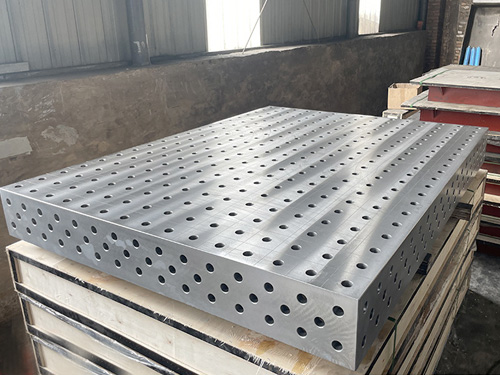
A reconfigurable (or modular) welding table uses a universal hole grid plus a library of standardized components—pins, angles, clamps, and stops—that assemble into any fixture and dismantle just as fast. Nothing is welded to the table; everything is reusable, so the same table serves hundreds of different parts over its life.
The mental shift is from "build a jig" to "assemble a fixture from the kit." That shift is what unlocks speed: the table is permanent infrastructure, and only the arrangement of accessories changes between jobs.
Benefits for High-Mix Production
Near-zero fixture fabrication – stop cutting and scrapping custom jigs.
Minutes not hours – setup collapses from a shift to a coffee break.
Repeatable accuracy – every part references the same calibrated grid.
Lower inventory – one kit replaces shelves of dead tooling.
Fast ramp – new part? Just reconfigure and weld.
Comparing Fixed, 2D, and Reconfigurable Tables
A fixed jig is unbeatable for one million identical parts, but hopeless for variety. A 2D T-slot table helps with flat work. A reconfigurable 3D table is the all-rounder for shops where no two days look alike. The right tool depends entirely on your production mix.
ROI You Can Quantify
Calculate saved hours per job × job count × labor rate, plus scrapped-jig material savings, minus the table cost. For shops running many unique jobs, payback is often under a year. A flexible 3D welding fixture platform turns fixed overhead into variable, on-demand tooling.
Do not forget the soft ROI: faster quoting, happier welders, and the ability to say yes to small orders that used to be unprofitable. Those wins compound over time.
Implementation Tips
Standardize on one grid ecosystem (28 mm bore) for all accessories.
Train welders to read a simple fixture sketch and build from the kit.
Keep a shadow-board of clamps so nothing walks off.
Document each fixture layout for repeat orders.
Reconfigurable Tables and Robotics
Many robotic cells mount a modular table and swap fixtures between programs, maximizing robot uptime. Because the datum is the table, a robot can be re-tasked in minutes rather than re-fixtured over days—a game-changer for contract manufacturers serving multiple clients.
Common Mistakes to Avoid
The biggest error is under-buying the accessory kit: a bare table with three clamps cannot deliver the promised speed. Buy the full starter kit, train everyone, and document layouts. The second mistake is mixing grid systems, which fragments the kit and erodes repeatability.
Comparison Overview
| Type | Setup time | Flexibility | Best scenario |
|---|---|---|---|
| Fixed jig | High (build) | None | Mass production |
| 2D T-slot | Medium | Medium | Flat-plate work |
| Reconfigurable 3D | Low | High | High-mix, low-volume |
Frequently Asked Questions
Is a reconfigurable table strong enough for heavy parts?
Heavy-duty versions on HT300 cast iron or thick steel handle substantial loads; match the table rating to your parts and add a base frame for large work.
Will repeatability suffer versus dedicated jigs?
No—if you reference the same grid holes and use locating pins, repeatability equals or beats hand-built jigs because the datum is the table itself.
How long does reconfiguration take?
Simple fixtures take 5–15 minutes; complex frames maybe 30–60 minutes versus hours for a welded jig.
Can I use it for both welding and inspection?
You can layout and tack on it; for final inspection use a dedicated cast iron platform or granite plate for stricter grades.
What training do welders need?
Basic: how the grid works, how to seat pins and clamps, and how to read a fixture plan. Most operators are productive after one session.
Does it suit robotic welding?
Yes—many cells mount a modular table and swap fixtures between programs, maximizing robot uptime.
Conclusion
Why HXR Tools for Your Workshop
A reconfigurable welding table converts fixture building from a bottleneck into a quick, repeatable step—exactly what high-mix shops need. Hebei Haoxinran Machinery Manufacturing Co., Ltd delivers modular 3D platforms, locator kits, and clamps engineered for fast changeovers. See the welding platform range or contact our engineers for a changeover plan.

Thomas Muller
 HOT PRODUCTS

 CONTACT US
—— E-mail:project@haoranmj.com
—— Whatsapp:+86 18932785670
—— Tel:+86 18932785670
—— Add:Across from Sanjing Distillery on Road 4, Botou Economic Development Zone, Cangzhou City, Hebei Province