







News Detail
T-Slot Cast Iron Welding Tables: Features, Configurations, and Selection Guide
author:hxrtools Time:2026-10-08 19:56:32 Click:99
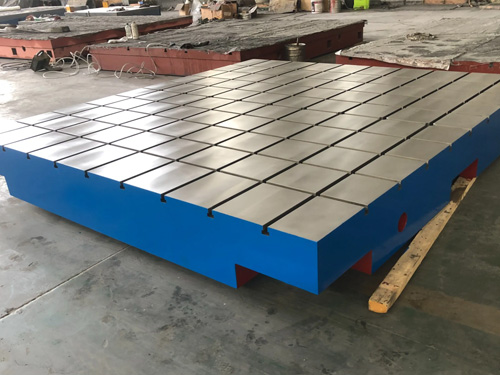
A T-slot cast iron welding table is the workhorse of any serious fabrication or training workshop. Its machined T-slots let you bolt down clamps, squares, and stops anywhere along the slot, giving a rigid, heat-stable base for welding and assembly. This guide covers slot patterns, 2D versus 3D configurations, material grades, flatness, and how to pick the right table for your operation.
Why Cast Iron for Welding Tables?

Cast iron—especially HT300 (GG25) grade—combines high compressive strength with natural vibration damping and good heat dispersion. Compared with fabricated steel plates, a cast iron welding table resists warping under repeated thermal cycles and stays flat, which protects your weld accuracy over years of use.
The graphite structure of gray cast iron also makes it self-lubricating for sliding fixtures and quieter under impact. For a surface that must remain a true reference while sparks fly and hammers land, cast iron is hard to beat.
Understanding T-Slot Patterns
T-slots run across the table at fixed pitches. Two pitches dominate: a coarse 100 mm pitch for heavy clamping and a finer 50 mm or 28 mm grid for flexible locating. Many tables combine a T-slot top with a bored grid so you can use both traditional clamps and modern locating pins.
The slot profile matters too. A standard inverted-T pocket accepts T-nuts from above, so clamps can be positioned continuously rather than only at hole centers. This continuous adjustability is why T-slot tables remain popular despite the rise of bored-grid systems.
2D vs 3D T-Slot Configurations
A 2D configuration uses slots only on the top face—ideal for flat-plate welding and layout. A 3D configuration adds bored grids on the sides so you can build vertical and angular references, effectively turning the table into a modular fixture station. Choose 3D if you fabricate frames, enclosures, or anything with out-of-plane features.
Hybrid tables that offer both T-slots and a bored grid give the best of both worlds: continuous clamping plus precise locating. They cost a bit more but cover the widest range of jobs.
Material Grade and Flatness
Insist on a documented grade. HT300 cast iron should meet recognized standards for tensile and hardness, and the working surface should be scraped or precision-milled to a defined flatness class. A cast iron platform intended for inspection will carry a stricter grade than a pure welding top, but both benefit from stress relief.
Flatness is usually expressed as a total deviation over the table's diagonal. Ask for the actual measured value, not just a nominal grade, especially for larger tables where distortion risk grows.
Selection Checklist
Overall size vs. your typical part envelope.
Slot pitch and whether a bored grid is included.
Material certificate (HT300 / GG25) and stress-relief process.
Leg/base options for stability and height ergonomics.
Spare clamp and T-nut kits.
Buy from a maker that controls casting and machining in-house, so material and flatness claims are backed by real process control rather than reselling.
Protecting the Surface from Spatter
Weld spatter is the enemy of any precision top. Use anti-spatter compound, copper or ceramic slot covers, and clean slots regularly with a brush; never grind directly on the surface. A few minutes of protection after each job preserves flatness and makes future setups effortless.
Sourcing and Lead Time
Standard sizes often ship in 2–4 weeks from established makers; customized tables take longer. Confirm material certification, flatness report, and packaging that protects the machined face in transit. A slightly higher ex-works price with documented quality is almost always cheaper than a warped bargain.
Comparison Overview
| Feature | T-slot (100 mm) | Bored grid (28 mm) |
|---|---|---|
| Clamping style | Bolts & T-nuts | Pins & quick clamps |
| Best use | Heavy, simple fixtures | Flexible, repeatable fixturing |
| Setup speed | Medium | Fast |
| Load capacity | Very high | High |
Frequently Asked Questions
What size T-slot welding table should I buy?
Size to your largest common workpiece with margin for clamping; a 1000×1000 mm or 1200×1500 mm table suits most job shops, while larger fabricators need 1500×3000 mm and up.
Is HT300 better than mild steel for welding tables?
For stability and warp resistance, yes. HT300 cast iron dampens vibration and holds flatness better under heat; mild steel is cheaper and lighter but more prone to distortion.
Do I need a 3D or 2D table?
If you only weld flat plates, 2D is enough. For frames, boxes, and angled assemblies, a 3D bored-grid table saves enormous setup time.
How do I stop weld spatter damaging the slots?
Use anti-spatter compound, copper or ceramic slot covers, and clean slots regularly with a brush; never grind directly on the surface.
Can T-slot tables be used for inspection too?
A precision-milled and stress-relieved cast iron table can double as a layout/inspection plate, but dedicated inspection grades are stricter—see our cast iron platform range.
What is the typical lead time from China?
Standard sizes often ship in 2–4 weeks; customized tables take longer. Verify with the supplier during sourcing.
Conclusion
Why HXR Tools for Your Workshop
The right T-slot cast iron welding table—matched to slot pitch, material grade, and 2D/3D needs—keeps your welds accurate and your floor productive. Hebei Haoxinran Machinery Manufacturing Co., Ltd manufactures HT300 cast iron welding tables, T-slot beds, and modular platforms to documented grades. Browse welding tables or talk to our team for a sized recommendation.

Elena Fischer
 HOT PRODUCTS

 CONTACT US
—— E-mail:project@haoranmj.com
—— Whatsapp:+86 18932785670
—— Tel:+86 18932785670
—— Add:Across from Sanjing Distillery on Road 4, Botou Economic Development Zone, Cangzhou City, Hebei Province