







News Detail
Welding Fixture Workbench: Boosting Accuracy and Throughput
author:hxrtools Time:2026-10-10 20:22:22 Click:69
A welding fixture workbench combines a rigid table with an integrated clamping and locating system so operators can position parts accurately and weld without distortion. Unlike a bare bench, a fixture workbench bakes repeatability into the workflow. This article covers clamping systems, hole patterns, ergonomics, and buying tips.
Anatomy of a Fixture Workbench

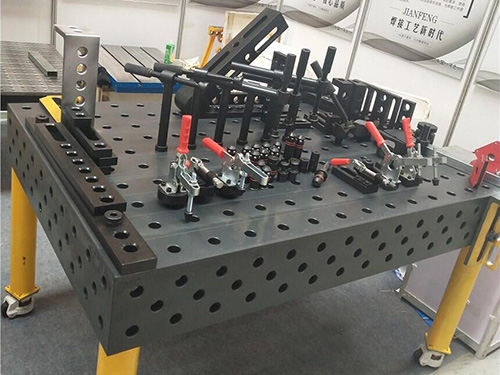
The core is a precision surface—cast iron or alloy steel—with a bored grid and/or T-slots. Around it sit quick-action clamps, magnetic squares, height stops, and angle brackets. The bench height and leg design affect ergonomics and stability, especially for all-day use.
Think of it as a workstation, not just a table: the framing, the height, the accessory storage, and the surface all work together to make accurate welding the path of least resistance.
Clamping Systems You'll Use
Screw clamps – high force, simple, reusable.
Toggle/clamp levers – fast one-hand operation.
Magnetic squares – instant 90° referencing.
Locating pins – repeatable hole-grid positioning.
Adjustable stops – define part edges quickly.
The best benches let you mix these freely, so a fixture is built from the right tool for each edge rather than forced into one clamp type.
Hole Pattern and Grid Logic
Most fixture workbenches use a 100 mm top grid with 28 mm boreholes (heavy) or 50 mm with 16 mm (light). The grid is what makes positioning mathematical rather than guesswork. A welding fixture workbench should publish its grid pitch and bore tolerance.
Ergonomics and Throughput
Bench height around 750–850 mm suits standing work; casters with locks add flexibility but reduce rigidity, so fixed levelling feet are better for precision. Good ergonomics reduce fatigue and rework, directly lifting throughput. A welder who is not hunching or reaching welds cleaner and faster.
Selection Guide
Decide grid pitch from part size and clamp style.
Pick material (HT300 cast iron for stability, steel for lightness).
Confirm flatness grade matches your quality needs.
Buy a starter clamp/accessory kit, not just the top.
Controlling Distortion While Welding
A rigid, flat bench gives you a true reference to manage shrinkage. Clamp symmetric, weld in balanced sequences, and let the bench absorb what it can. Fixture workbenches turn distortion control from art into procedure.
Workbenches in Automated Cells
Many automated cells use a fixture-ready bench as the station base, swapping fixtures between robot programs. The bench's flatness and grid become the cell's coordinate origin, simplifying offline programming and repeat orders.
Comparison Overview
| Element | Why it matters |
|---|---|
| Grid pitch | Determines locating resolution and clamp spacing |
| Bore tolerance | Drives repeatability of every fixture |
| Table flatness | Protects weld geometry and downstream fit |
| Leg rigidity | Stops vibration and table bounce while welding |
Frequently Asked Questions
What is the difference between a fixture workbench and a welding table?
A welding table is the bare surface; a fixture workbench includes the clamping/locating ecosystem and often ergonomic framing, so it is ready for repeatable fixturing out of the box.
Should the top be cast iron or steel?
Cast iron (HT300) gives stability and warp resistance; steel is lighter and cheaper. For precision fixturing, cast iron is preferred.
Can I add fixtures later?
Yes—choose a system with a standard grid so you can expand the clamp and locator library over time.
How do I prevent distortion while welding on it?
Clamp symmetric and weld in balanced sequences; the rigid, flat bench gives you a true reference to control shrinkage.
Is a 28 mm or 16 mm grid better?
28 mm for heavy/structural work; 16 mm for finer sheet-metal and prototypes. Match to your parts.
Do these benches work with robotic cells?
Many modular benches are robot-ready; you swap fixtures between programs to keep the cell running.
Conclusion
Why HXR Tools for Your Workshop
A welding fixture workbench makes accurate, low-rework welding the default rather than the exception. Hebei Haoxinran Machinery Manufacturing Co., Ltd builds fixture-ready tables, clamp kits, and modular platforms for fabrication shops. Browse welding fixture tables or contact us to outfit your workstations.

Olivia Brooks
 HOT PRODUCTS

 CONTACT US
—— E-mail:project@haoranmj.com
—— Whatsapp:+86 18932785670
—— Tel:+86 18932785670
—— Add:Across from Sanjing Distillery on Road 4, Botou Economic Development Zone, Cangzhou City, Hebei Province